
Searching Civil Dockets in Indiana
MyCase is the Indiana Courts Case Search. It indexes public civil case information from courts on the Odyssey system. Pick Case, Party, or Attorney mode. Then narrow by civil category where the court's filters allow it. Circuit and Superior Courts carry the broad civil dockets. Local assignment plans decide which court or division takes a given claim.
The full CCS and case papers stay with the court that heard the matter. Most county Circuit and Superior files run through the Clerk of the Circuit Court. A City Court or Marion township small-claims case can have its own local clerk. Search statewide first and confirm the court. Then use the county directory for county-level court and clerk routes when a record is not online.
- Choose Case, Party, or Attorney mode in MyCase and enter one useful identifier.
- For a party search, start with the stored last name and add first name, middle name, or other refiners.
- Filter results by court, civil case type, status, or filing date to narrow a large result set.
- Open the CCS and confirm the court assignment before seeking a filing that is not linked online.
- Contact the record custodian for a plain or certified copy, and confirm local fees, payment, and delivery.
Search Civil Cases in MyCase
MyCase has no civil-only portal for Indiana. Its Case, Party, and Attorney modes return civil, family, probate, criminal, citation, and appellate cases. What you get depends on the court and filters chosen. A case search takes one case number, citation number, or cross-reference number. A person search needs a last name. That pairs with a first name, middle name, or date of birth. Business and attorney searches use their own fields.
The official Indiana MyCase Search Tips page lists the inputs and refinements. Trim results by court, case type, open or closed status, or filing date. In an Indiana Rule 8 number, hyphens and leading zeroes are optional. A search stops at 1,000 records. When common names or busy dockets flood the results, add court, date, or name detail.
The public MyCase search screen offers Indiana's statewide lookup. It covers case, party, and attorney searches for civil dockets across the state.
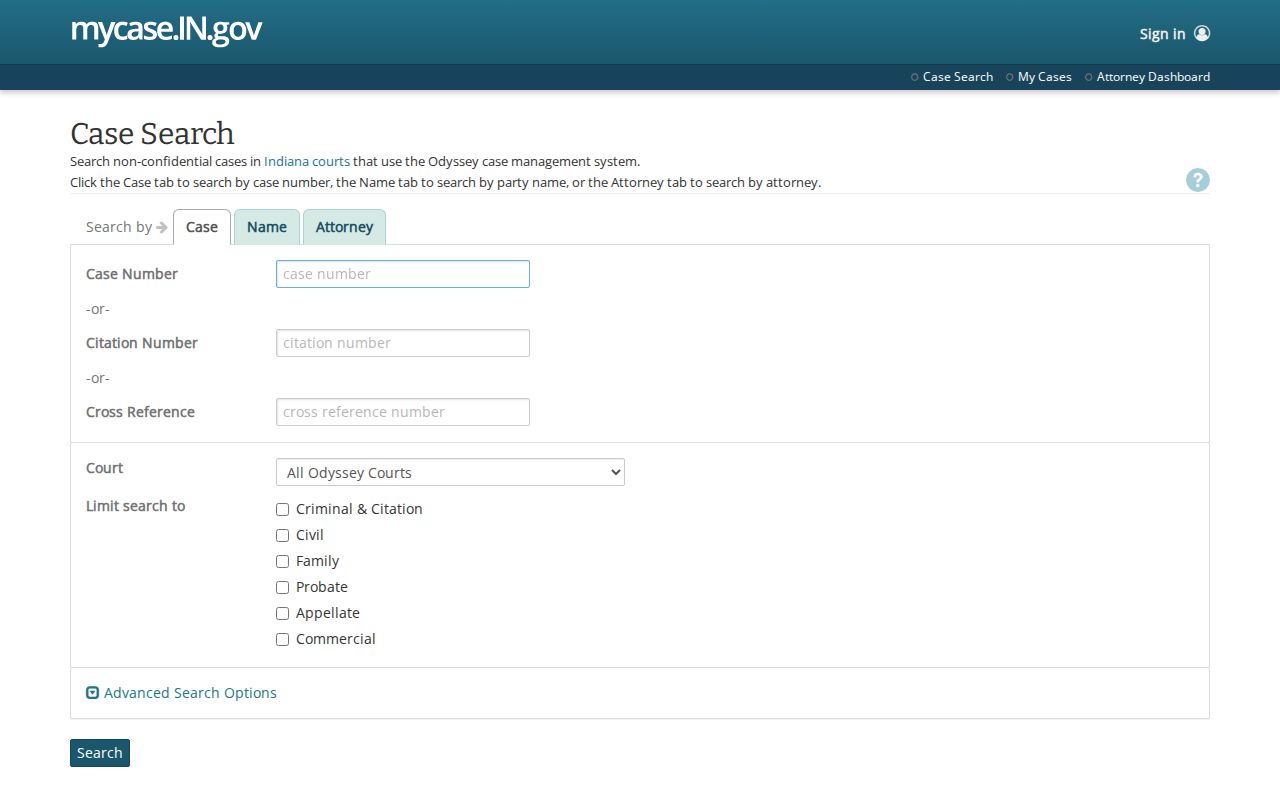
The result names the case and can display its CCS. Document links depend on case type, age, and access rules.
Note: Indiana party searches can miss a case when DOB is added because many civil records lack that field.
What an Indiana Civil Docket Shows
The Chronological Case Summary is Indiana's official dated register of court events. Indiana Trial Rule 77 says it holds the case title and number, attorney or self-represented party information, public receivables, event dates, and brief descriptions of filings, orders, rulings, or judgments. The CCS shows the sequence of a civil case. It is not the whole case file. A MyCase entry may link a public order or other paper. That depends on case type and Indiana access rules.
| Case Number | Indiana Rule 8 includes a county/court identifier, filing year and month, case type, and sequence. Schematic pattern: county/court-YYMM-PL-sequence. |
|---|---|
| Parties | An Indiana complaint may name a plaintiff and defendant; a petition may use petitioner and respondent. Attorneys’ appearances can be recorded as events. |
| Filings and Orders | The Indiana chronology can list a complaint, service, answer, motion, discovery filing, order, or judgment, but not every item has an online image. |
| Settings | Indiana hearing notices may show a date, time, courtroom, judge, or type of setting; a later reset can replace an earlier date. |
| Judgment | An Indiana judgment entry records a court action or result. Read the signed order to learn whether it followed trial, agreement, default, or another path. |
A motion asks the court to act; an order records its direction or ruling. Read "dismissed" or "default" against the signed order and any claims still active.
Indiana Civil Case Codes
Indiana Administrative Rule 8 codes sort civil cases into families. The code marks the filing category, not a ruling. Filters in MyCase vary by court, so use the current Indiana case-number rule to decode an unfamiliar number.
- PL
- Indiana civil plenary matter, a broad civil case category.
- CT and CC
- Indiana civil tort and civil collection case types.
- SC
- Indiana small-claims case. The general small-claims limit is $10,000 for cases filed on or after July 1, 2021, subject to governing provisions.
- EV
- Indiana eviction case type for cases filed on or after January 1, 2021; older eviction cases may retain SC.
- MF, DC, and DN
- Indiana mortgage foreclosure and domestic-relations categories; family case type can affect document access.
Other Indiana codes cover commercial-eligible matters, probate, protection orders, mental health, tax, and judicial review. Case type points to a docket lane. It does not decide whether every document is public.
Note: Indiana court selection can change available case-category filters, so a civil search under the wrong court may omit relevant results.
Civil Case Types on Indiana Dockets
Indiana civil dockets span contract and collection claims, tort and property disputes, foreclosures, family and probate matters, small claims, and evictions. Circuit and Superior Courts share broad civil jurisdiction. Local plans assign each case to a court or division. City Courts hold limited statutory civil authority. The court title alone won't identify the right docket lane.
Small claims use a simplified process. Plenary cases can include pleadings, discovery, motions, and trial. A commercial-eligible code marks a local docket, not a separate state portal. EV covers Indiana evictions filed from 2021 onward; older ones may sit under SC. Follow the case number, court identifier, and actual event history.
Indiana Small Claims: $10,000 Limit
The Indiana Small Claims Manual sets a general $10,000 limit for claims filed on or after July 1, 2021. Not every smaller claim must use that docket. Assignment, statutory exceptions, and the relief sought still matter. See the official Indiana Small Claims Manual for current practice guidance.
Routing point: Indiana small claims usually sit in a Circuit or Superior Court division. Marion County has a separate nine-township small-claims arrangement, so this Indiana docket may require a township clerk route.
City Court civil authority varies by statute and community. A claim moved to a plenary docket may carry a new case type or number. Confirm the current court rather than trusting the amount claimed.
Indiana Civil Settings and Hearings
Pull up an Indiana civil case on CCS. The calendar may show a status conference, a motion hearing, pretrial, trial, a small-claims hearing, an eviction hearing, or a settlement conference. Local courts pick their own labels for these settings. A notice usually lists the date, time, location, judge, and setting type. If two dates conflict, the signed order controls, or call the Indiana clerk to confirm.
Indiana also offers a separate Indiana Trial Court Calendars app. But it only covers courts that choose to publish there. It is not a full MyCase history. A continuance is a postponement the court approved. A reset is just a local label for a new date. When a setting changes, read the latest docket entry and confirm with the court.
Note: Indiana’s Trial Court Calendars app lists only courts that choose to publish there, so its schedule is not a complete statewide case history.
Indiana Civil CCS and Filing Images
A civil CCS lists events, not every document behind them. The case file can hold a complaint, a service return, an answer, a motion, an order, or a judgment. The docket may show only a single event line. Trial Rule 77 puts the county clerk in charge of the CCS, the case file, the Record of Judgments and Orders, and the indexes. Some older records are paper, microfilm, or converted material. So online date coverage varies by county.
| What appears | What it answers | Next route |
|---|---|---|
| CCS event line | When the court recorded an event and its short description | Open any linked paper, then check the clerk if no image appears |
| Filed document | The actual complaint, motion, service paper, order, or judgment | Check the public access matrix and ask the court-file custodian |
| Certified copy | A clerk-authenticated copy for formal use | Request certification and confirm the local fee and delivery method |
What you can see online depends on who you are. It also depends on the case type. The public document matrix shows broader online access for some papers. Nonconfidential CT, CC, PL, and MF filings qualify. Other categories may show only selected orders, or none at all. A missing PDF does not mean the filing never happened. Ask the clerk whether it is public. Then ask how to get it: in person, by mail, email, or a local form.
2024 Indiana Small-Claims Dispositions
The 2024 Indiana Judicial Service Report counted 95,330 small-claims dispositions in courts of record. That number covers the whole state. It is not any one county's docket. It also does not capture every local claim and eviction. The 2024 report is the newest finalized annual dataset.
Broad searches for small-claims and collection cases often return near-identical captions. Narrow your results by court, date, party, and case number. Treat the statewide count as context. Do not treat it as proof that every disposition appears in MyCase.
Note: Indiana report categories may group municipal or local matters differently from courts of record, so statewide counts are not individual-court totals.
Indiana Civil Docket Access
Indiana court records are public under Access Rule 4. Rule 5, another law, or a court order may still seal the case or document. Juvenile and mental-health cases sit among the confidential classes. Some family papers and personal identifiers are restricted too. MyCase allows free anonymous searches, and some local courts add their own online docket.
Eligible records can be viewed in person. You can also view them at courthouse public terminals during normal court hours. Mail, email, phone, and online request forms depend on the clerk. No single statewide form, ID rule, fee, or turnaround applies. County Circuit and Superior files usually run through the Clerk of the Circuit Court. City Courts and Marion township small-claims may use local clerks instead.
Chasing a missing public document? Give the court the cause number, the parties, the filing, and the approximate date. Administrative Rule 9 governs the court-record process. The Indiana Access to Public Records Act covers records within its scope. It recognizes Supreme Court rulemaking over court-file access. It sets no uniform case-file deadline. The judiciary's records request page routes requests by record type. Copy fees start at a $1-per-page baseline in the Trial Court Fee Manual. The manual also lists a $1 certificate fee. Confirm the local schedule, payment, and delivery with the clerk; court reporters handle transcripts.
Access rules:
Access Rule 5 names confidential case types and documents that must be withheld from public access.
Access Rule 6 sets the process for a narrowly tailored court-ordered restriction.
Administrative Rule 9 covers remote and courthouse access, daily calendars, fees, and court-record requests.