
Inside the Indiana Court System
Indiana runs three appellate bodies. These are the Supreme Court, the Court of Appeals, and the Tax Court. Trial work sits with the Circuit and Superior Courts. Every county has a Circuit Court. Superior Court setup and local case assignments differ from place to place. City and Town Courts take smaller matters, including ordinance violations, misdemeanors, and infractions. A court's title alone tells you little. Check the court identifier and local assignment before assuming where a case record lives.
| Court level | Typical record | Record custodian |
|---|---|---|
| Circuit and Superior Courts | County criminal, civil, family, probate, and small-claims matters as locally assigned. | County Clerk of the Circuit Court. |
| City and Town Courts | Local ordinance cases, misdemeanors, infractions, and limited civil matters. | Local court clerk. |
| Indiana Tax Court | Specialized tax appeals and related case history. | Appellate Clerk. |
| Court of Appeals and Supreme Court | Appellate CCS for an appeal or original proceeding. | Appellate Clerk. |
In Indiana, the clerk of the circuit court in each county keeps the CCS files for Circuit, Superior, and Probate cases. That duty is set out in Indiana Trial Rule 77. City and Town Courts may keep their own dockets with a separate clerk. When a case is appealed, a second CCS opens at the appellate level. The trial court record stays put. For the full layout of courts and who holds their records, Indiana's court-system overview walks through the hierarchy.
Indiana Trial Court Assignments Vary
Circuit and Superior Courts share general trial jurisdiction across Indiana. But local rules decide which court or division gets a case. Misdemeanors and infractions can land in either county courts or City and Town Courts. Local civil jurisdiction is limited and depends on statute. Indiana has no Justice of the Peace tier. So a traffic ticket lookup should pin down the actual court named on the citation.
The judiciary counts more than 400 trial courts. Roughly 300 of them serve county areas. The rest are tied to city, town, or township government. Small-claims dockets usually sit inside Circuit or Superior Court. Marion County runs township small-claims courts instead, though. Probate matters generally go to a Circuit or Superior division, apart from the distinct St. Joseph Probate Court. Confirm the court identifier and its clerk directly. Guessing from the case type alone leads people to the wrong docket.
The Indiana Statewide Search Portal
MyCase, also known as Indiana Courts Case Search, is a free public docket search covering nonconfidential data from courts on the Odyssey system. It reaches most Indiana courts, not all. Some converted records are included. Trial and appellate cases both appear, but older material and document images vary by court. The Indiana case lookup guide walks through the steps. One caution: MyCase finds a case, yet it is not a certified court record.
| MyCase feature | What it provides | What remains local |
|---|---|---|
| Case index | Public cases recorded by participating Indiana Odyssey courts and some converted records. | Nonparticipating Indiana local courts and incomplete legacy history. |
| CCS view | Public Indiana case summary and chronological events. | The Indiana clerk's official CCS and full case file. |
| Documents | Selected Indiana document links allowed by case type and user role. | Unlinked filings and papers restricted from public view. |
| Updates | Online view of Indiana court-record information. | No universal public refresh-time guarantee; confirm current facts with the clerk. |
Note: MyCase only covers participating Odyssey courts and some converted cases. A blank result does not mean no local court file exists.
Indiana Courts Portal Has a Separate Audience
The Indiana Courts Portal serves a different crowd. Attorneys, firms, mediators, judges, and court employees sign in to exchange data with the Office of Judicial Administration (OJA). It offers no public browsing of case histories or documents. For a public case lookup, MyCase is the right door.
The Indiana Courts Portal sign-in page confirms the separate service. Its restricted audience does not block public access to a court record.
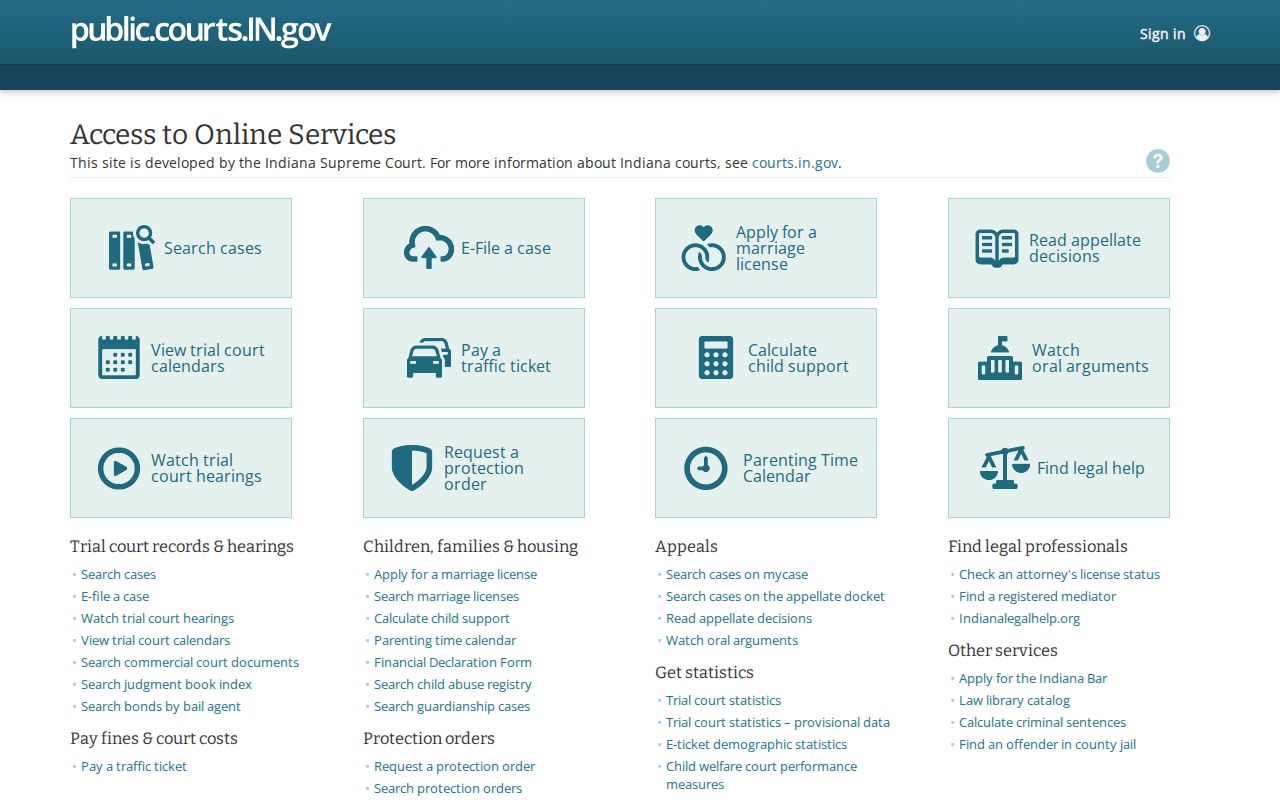
Think of the Portal as a secure staff and attorney tool. It is not a public MyCase search screen. Public access depends on what the court records and rules let MyCase display.
How Indiana Dockets Reach the State Index
Every Indiana filing or court event starts at the local court and clerk. Where the court runs Odyssey, that local CCS feeds MyCase. That public view shows legally open information. The statewide search only reflects participating courts. It does not create the county's official case history. Nor does it absorb every paper sitting in the local file.
Docket flow: Local filing or court event › Court and clerk's CCS in Odyssey when used › MyCase public view of legally public case information
A local Indiana court might use a different system. A filing might not be public online, or an older record may never have been converted. When the statewide index falls short, the responsible Indiana clerk or local court is the next stop.
Indiana Court Administration Connects Shared Tools
The Office of Judicial Administration (OJA) supports the Indiana Supreme Court's administration. Its Court Technology unit backs statewide applications, Odyssey, MyCase, and e-filing. The Office of Court Services gathers trial-court and probation data. It also publishes statistics and runs court programs. Even so, local courts enter their own events and clerks keep the case files. For scale, the 2024 Indiana Judicial Service Report counted 1,144,342 cases filed and 1,218,658 disposed. Those totals describe workload, not the coverage or outcome of any single case.
Trial Court Calendars is a separate schedule service drawing on participating courts. It is not a full CCS or a list of every hearing. A calendar shows a listed event. The case record shows the wider run of filings and orders behind it. The Indiana Office of Judicial Administration and the Trial Court Calendars service describe these roles. They do so directly.
Note: Trial Court Calendars is opt-in. Its listings never fully replace MyCase's chronological case history.
Indiana Odyssey Coverage Is Court-Specific
Participation in Indiana's Odyssey system is tracked court by court, not county by county. A county's circuit or superior court may run on Odyssey. Its City or Town Court can stay off it. The state roster lists court identifiers and start dates, and it also flags planned, abolished, and renumbered courts. So there is no single year when every Indiana court came online. Older matters may still show up as converted data. Before assuming a whole county participates, check the official Odyssey court roster for the specific court handling the docket.
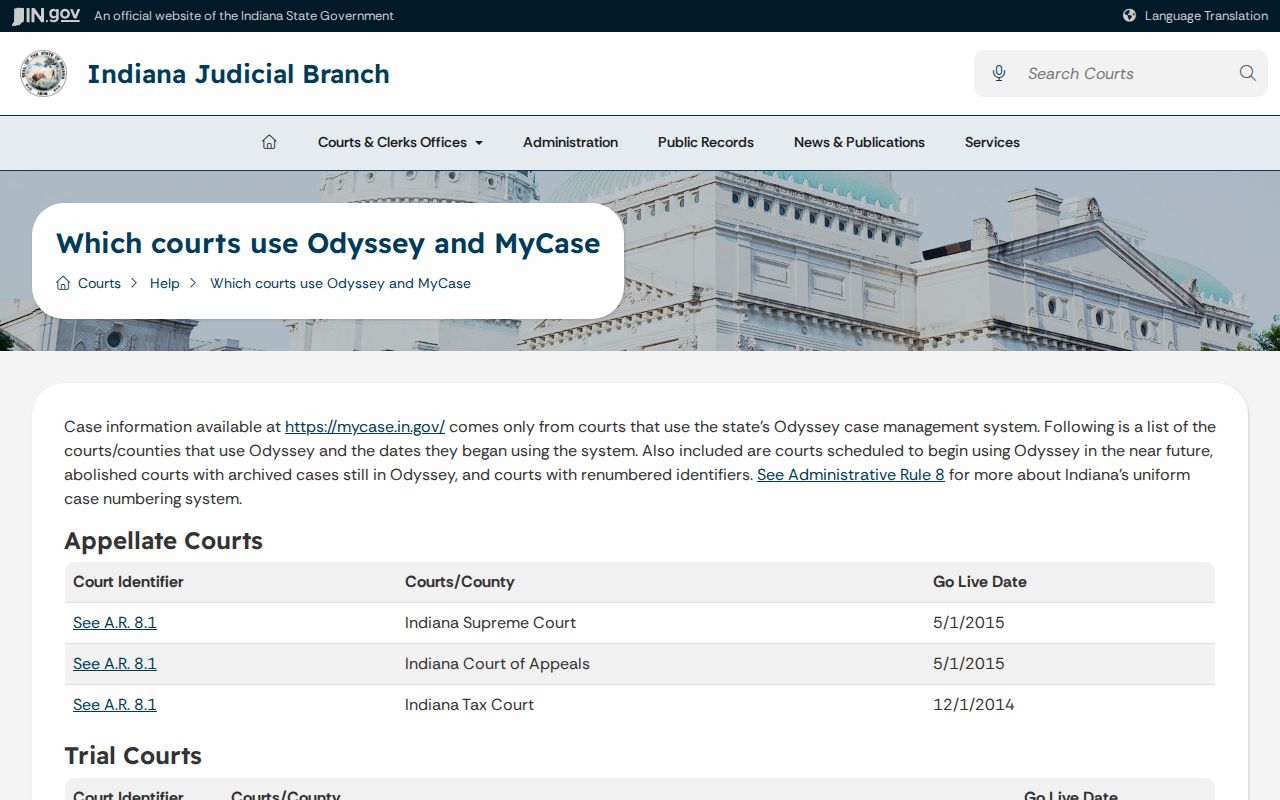
Two courts sitting in the same area can carry very different online coverage. When a case lookup returns nothing, the reason could be participation, the age of the record, or a confidentiality rule. The local court can tell you which one applies.
E-Filing Through Indiana's E-Filing Manager
Indiana's E-Filing Manager moves submissions from approved providers into local court systems across the state. Its schedule covers more than 40 case types. Availability is marked by court and by case type, in both appellate and trial courts. Some City and Town Courts are not yet implemented or mandatory. Attorneys generally must e-file where it is required. Self-represented litigants are not bound to file electronically.
Filing electronically moves a paper into the court's workflow. It does not change who keeps the record. The court logs the event in its own case-management system. Indiana access rules then decide what becomes public. Providers add their own convenience charges on top of court filing fees. Those amounts vary. Remember that public case search happens through MyCase, not through e-filing.
The state's e-filing overview, the court and case-type schedule, and Administrative Rule 14 lay out the filing route and when it applies.
Note: Indiana e-filing delivers papers to the court's case-management workflow. It is not a public search tool and does not decide document access.
Indiana E-Filing Is Separate From Public Search
Indiana's E-Filing Manager and MyCase handle two different jobs. E-filing submits and serves the papers; MyCase is the public index for participating courts. Whether the public can open a filed PDF turns on Indiana access rules, how the court processes the filing, and the user's own role. A receipt from a successful filing never promises a public document link.
| Task | Indiana e-filing | MyCase |
|---|---|---|
| Primary use | Submit and serve papers. | Search public cases and permitted links. |
| System role | Routes papers into local court workflow. | Shows court-record information to the public. |
| Case history | Not a public browse tool. | Searches cases and CCS events for participating courts. |
| Document access | Submission does not set access. | Case type and rules determine visibility. |
A filing can go through cleanly and still leave no public PDF. The clerk's case-management system and the access rules govern the court record. MyCase simply displays whatever online view is permitted.
Indiana Portal vs County Docket
MyCase finds public cases across participating courts. Yet not every court, older event, or document shows up there. For the official trial record, the county clerk's CCS and case file govern. Treat a search result as a pointer to the right court. Then use the Indiana county directory for the local route to a full docket, an unlinked paper, or a certified copy.
| Record question | MyCase statewide index | County or local court |
|---|---|---|
| Coverage | Participating Odyssey courts and some converted data. | Local files and systems maintained by the court. |
| Docket detail | Public index and available CCS events. | Official CCS and full trial file. |
| Documents | Selected links by case type and audience. | Ask about an unlinked public paper. |
| Certified copies | Online display is not certified. | Request from the record-holding clerk. |
The directory gives you the contact path to a county clerk or local court. Ask whoever holds the record about local search access. Older paper or microfilm files may need a separate request.
Note: The Indiana county directory is the next contact step for clerk-held CCS files and unlinked public papers. It also serves older records and certified copies.
Indiana Appellate Cases Open Separate CCS Records
An appeal opens its own CCS record while the trial case stays below it. Indiana's Appellate Case Search lets you search by litigant, attorney, appellate number, or lower-court number, with filters for court, case type, and dates. For older matters, the related-case links may not be complete.
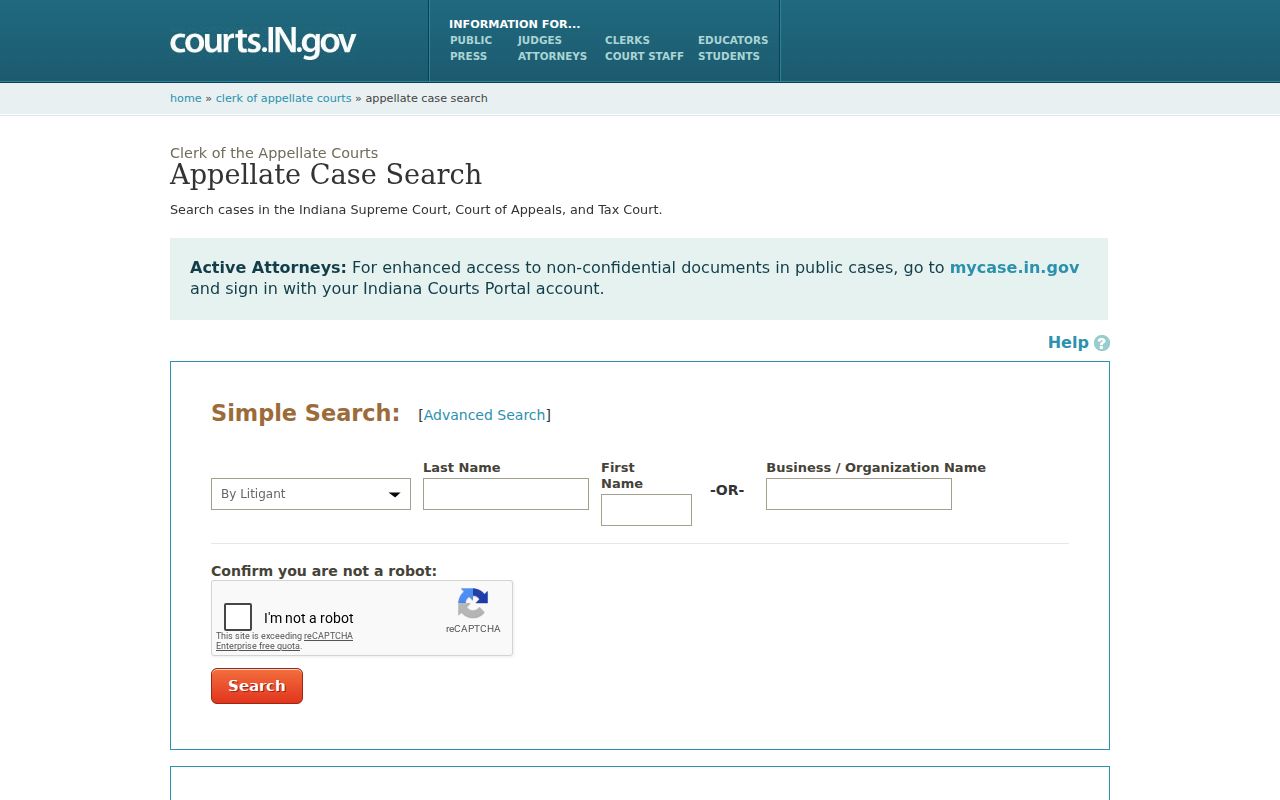
The appellate docket tracks appeal activity only. It is not the lower court's full file. Trial papers stay with the county clerk, and any hearing transcript stays with the court reporter. Indiana's official Decisions search guide covers the separate public tool for opinions and orders.
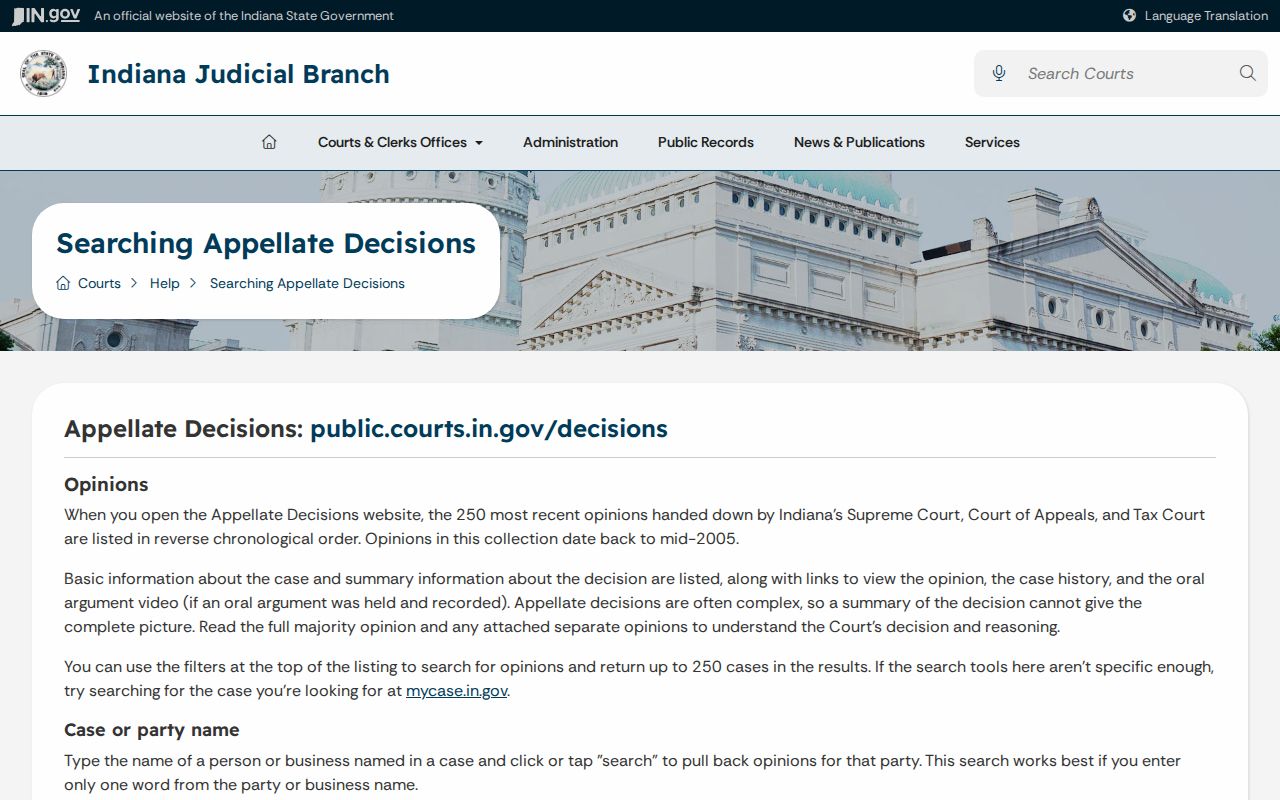
Decisions search returns published opinions and orders, not the docket's full event history. The Indiana Appellate Clerk provides the contact route for record requests and certified copies.
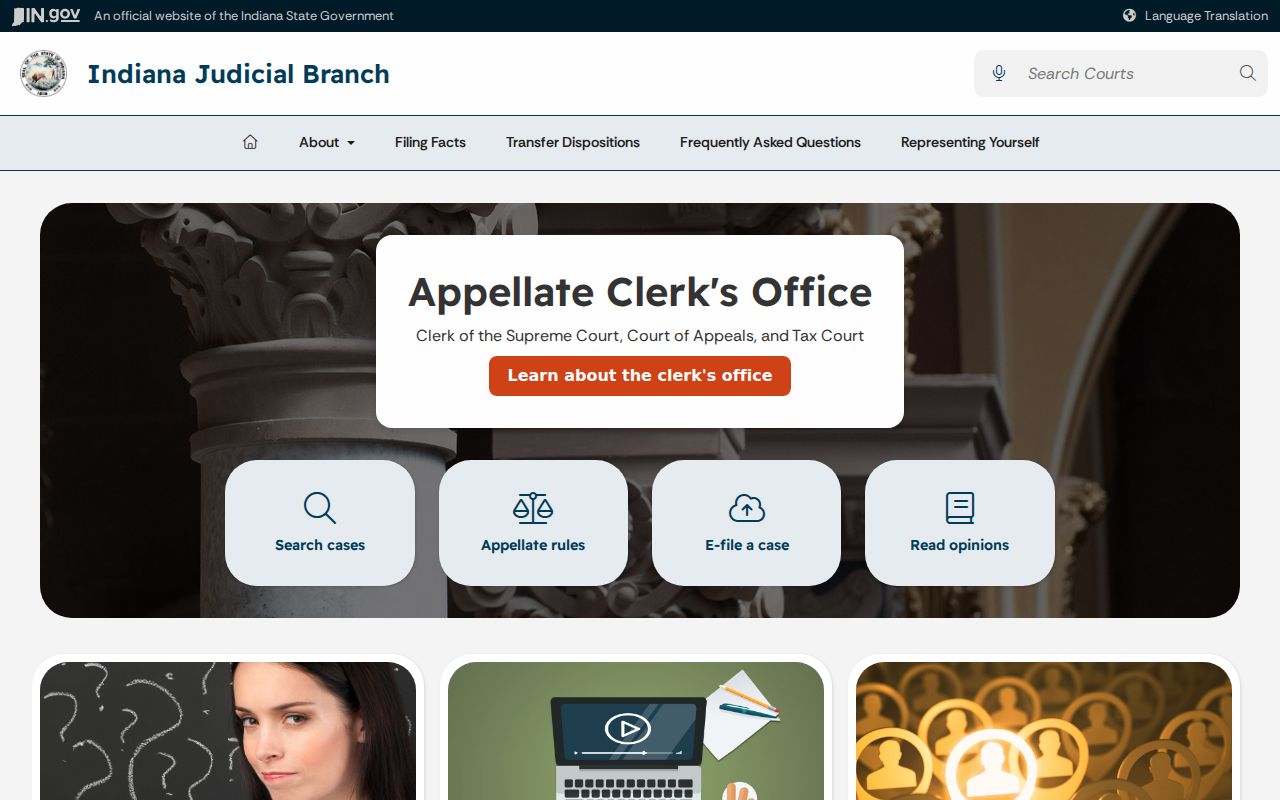
Direct requests for appellate records to the Appellate Clerk. For trial papers or a lower court's official CCS, contact that court's own clerk.
Indiana Court Technology and History
Indiana's push toward connected case management began in 2002. A procurement reset followed. The Supreme Court then chose Tyler Technologies' Odyssey. The first deployments came in 2007, and courts joined in waves after that. That history explains why MyCase holds converted entries yet promises no complete online archive of Indiana court records. Indiana's Odyssey overview describes the state-supported case and financial system. It is built centrally, while each local court keeps its own rules and records.
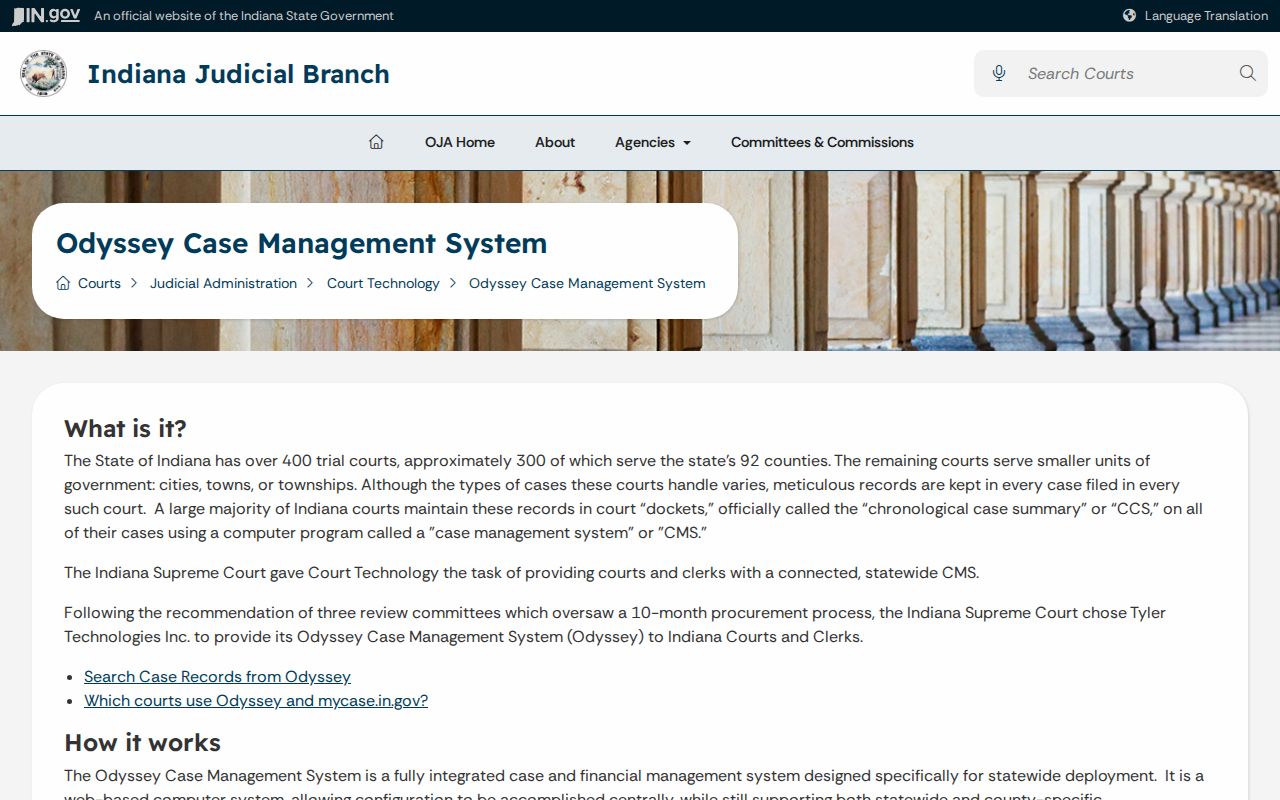
Odyssey reaches beyond the courts themselves. The judiciary's integration list includes BMV CDL violation reporting. It also covers tax warrants and the Electronic Citation and Warning System. These ties help run court administration. They do not fold every agency record into the public docket.
Key milestones show a court-by-court rollout, not one launch date:
- 2002: statewide case-management planning began.
- 2005: renewed procurement selected Tyler Technologies.
- 2007: early Odyssey deployments started.
- 2013: the judiciary's annual report counted 168 courts in 46 counties and more than 12 million Odyssey cases.
- 2014: Tax Court began using Odyssey.
- 2015: the Supreme Court and Court of Appeals moved to Odyssey.
- 2020: Trial Court Calendars launched for courts that opt in.
A statewide portal tells you where a court docket lives. It does not tell you how far back it goes. Joining the system did not happen all at once, and it did not recreate history. Indiana Odyssey brought courts online in waves starting in 2007. Converted entries fall short of a full statewide archive. Use the roster to find the right court, then ask the clerk directly about older records and the official docket.