
Searching Indiana Court Dockets
Begin with the Indiana public case search. Use it when a party name, citation, or case number is in hand. MyCase gathers nonconfidential entries from Indiana courts running Odyssey. It works well as a statewide starting point. Still, it is not the official paper file. Older records and some courts sit outside it. The county Clerk of the Circuit Court keeps the official Chronological Case Summary (CCS) plus the file for Circuit, Superior, and Probate matters. A citation from an Indiana city or town court may carry a separate local record too. A complete docket search therefore runs in two steps. Locate the case first, then confirm details with the court that holds it.
- Open Indiana MyCase and choose a case, party, or attorney search; its public search page is linked in the details below.
- Enter the strongest detail available. An Indiana Rule 8 case number is usually more exact than a common name.
- Check the Indiana court name and county in the result, then read the CCS from newest entry back when confirming a current setting.
- If the case or document is missing, confirm that exact Indiana court’s Odyssey status and ask the clerk or local court to search its files.
Check the court and case type before calling any Indiana result complete. A docket entry, a linked order, the case file, and a certified copy are four different records in an Indiana case. Appeals add another wrinkle. If a case climbs to an appellate court, a second CCS may exist, so the right search path depends on the court level.
Search Indiana Court Cases in MyCase
MyCase serves as the statewide public entry point for Indiana cases. The cases come from participating Odyssey courts. Three search tabs drive it. Case takes a case number, citation, or cross-reference. Party takes a last name or business name. Attorney takes an attorney number or name. Filters narrow any Indiana docket search by court, category, status, and filing date. Notice what is absent. There is no County field. So participating county, city, town, and appellate courts all appear inside the Court selector instead.
The Indiana MyCase public search screen presents the central search service itself. A case record there can list parties, court, status, CCS events, and links to documents. Those document links depend on case type and reader role.
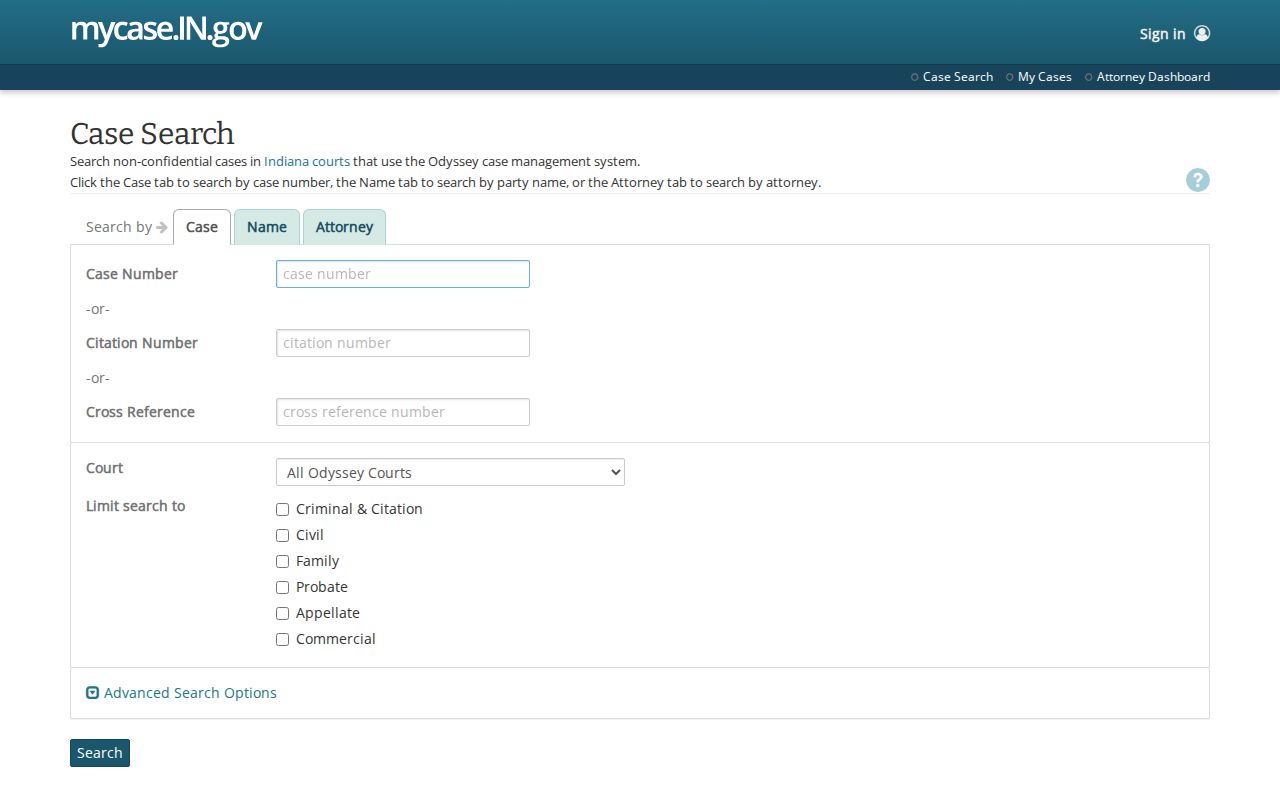
Search by case number whenever you have one. For a party search in Indiana, extra name detail helps. But a date-of-birth filter can hide a case when the court never captured that detail. Attorney search accepts a bar number. A trailing asterisk works as a starts-with wildcard on supported name fields. The sounds-like option cannot pair with a wildcard. Run the same query too many times and a CAPTCHA may appear. The court deters bulk collection.
| Search path | Useful input | What to check |
|---|---|---|
| Case | Indiana Rule 8 number, citation, or cross-reference | Citation formats are not uniform; exact text may matter. |
| Party | Last name, first or middle name, or business name | DOB is not public and may be missing from civil or criminal records. |
| Attorney | Attorney number or name | Name search needs a last name plus first or middle name. |
| Filters | Court, type, status, filing date | Options can change with the selected court. |
Indiana MyCase lists 20 results per page by default. It cuts off at 1,000 matches. Trim a broad name or wildcard query with court or filing-date filters. A empty screen proves little, though. Participation, confidentiality, and historical conversion all shape what the docket search returns.
Note: MyCase costs nothing to search. But a screen print is not a clerk-certified copy of an Indiana court docket.
Inside the Indiana Statewide Case Search
MyCase pools public indexes from participating Indiana courts, trial and appellate alike, under each court's own participation and access rules. It is not a statewide copy of every file. The participation roster lists court identifiers and start dates, and county participation alone never guarantees that a separate city or town court appears.
Some Indiana legacy data was converted. There is no single historical start date statewide, though. A transfer can spawn a new case number, and while online history may link old numbers, a clerk may still need paper, microfilm, or older indexes. The county Clerk of the Circuit Court keeps the county CCS and file.
Indiana e-filing routes submissions into local court systems. It does not replace MyCase's public case-history search. For the official record, a balance, or a setting, contact the court that holds the case.
Why an Indiana Case May Not Appear on MyCase
MyCase covers "most" Indiana Odyssey courts, not all. Participation is tracked by court identifier. So an Indiana county Circuit Court can appear while a city or town court in the same area stays out. Its citation is then missing from the index. Before deciding a case does not exist, check the statewide Odyssey court roster.
Other gaps come from confidentiality or age. Juvenile and mental-health matters may be closed as whole cases. Sealing or expungement can pull a record from public view. Even a public case may show a withheld document. Older Indiana files may live on paper or microfilm. Converted entries are not always new filings.
Verify the court and case number. Retry a prior number after a transfer, and loosen filters that cut too tight. If the Indiana public case still fails to appear, ask the filing court or county clerk to search its register. A gap in the docket is not proof that no case exists.
How to Confirm an Indiana Court Date After a Reset
A court date in Indiana can shift after it first shows up. A continuance leaves the old setting in place and adds a later one. The top line on a docket is not always the next hearing. Read the newest CCS entry plus any linked order or hearing notice before you count on a date. When a court publishes there, Trial Court Calendars helps too.
The calendar search works by county, court, and date, or by case name or number. Joining is optional for courts, so its roster of courts differs from the Odyssey list. Broad searches run into a daily cap on results. The date window keeps rolling over. The public Indiana Trial Court Calendars interface is where the schedule search happens.
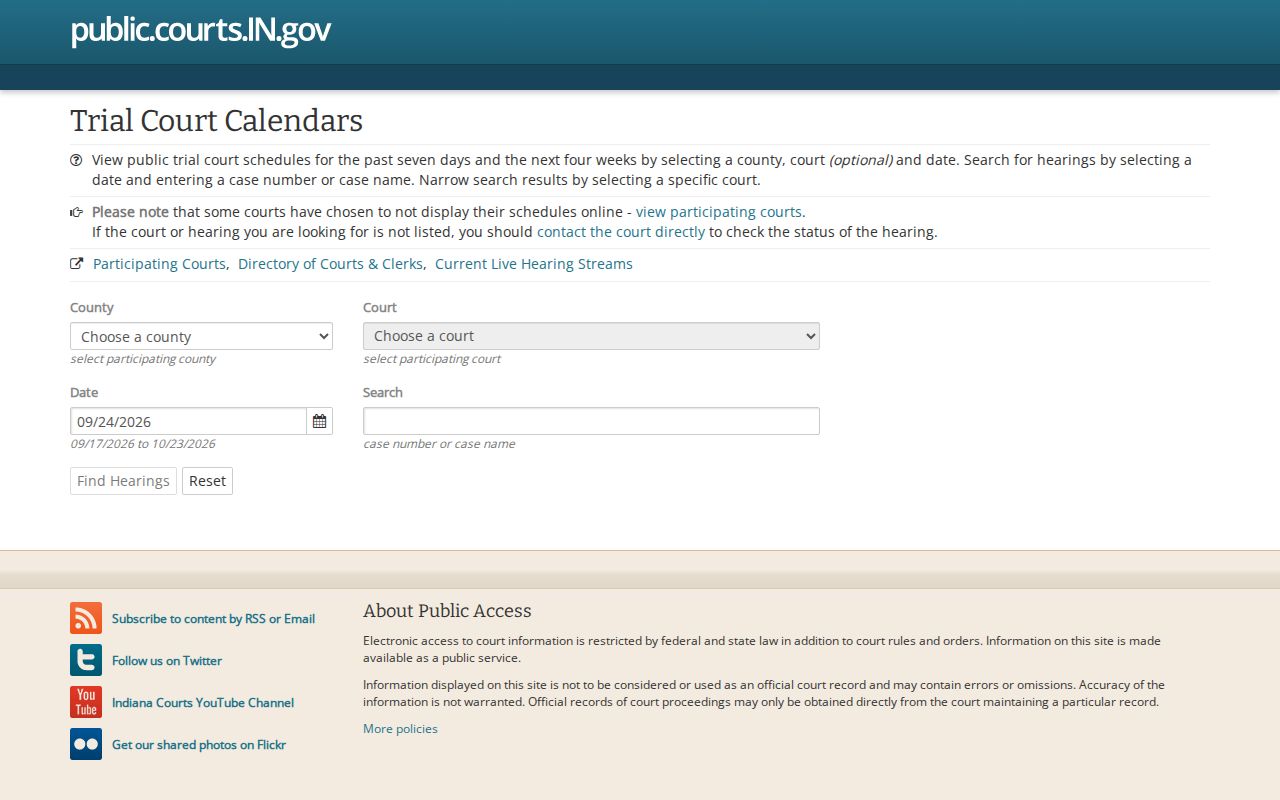
When an Indiana hearing is close, has moved, or is missing, pick up the phone. Call the assigned coordinator or the calendar clerk directly. The county clerk can tell you which court holds the case. A city or town ticket may sit with that local clerk instead. For an appellate argument, trust the appellate case record and schedule. Do not rely on an older CCS setting.
Note that Indiana Rule 9 requires a public daily calendar. It does not force every court to publish in the same online application.
Which Indiana Courts Keep Dockets
Indiana organizes its county trial courts into Circuit and Superior Courts. Each county has exactly one Circuit Court. Superior Court counts and divisions differ from place to place. Both handle a broad mix of civil and criminal work, and local plans decide which division takes a given case. City and town courts stay narrower, covering ordinances, misdemeanors, infractions, and limited civil matters. Marion County adds township small-claims courts on top of these.
Whoever hears the case keeps the CCS in the local case system. Under Trial Rule 77, the Clerk of the Circuit Court maintains the file. That covers county Circuit, Superior, and Probate records. A city or town court may run its own clerk's office. The Indiana court structure overview walks through the levels of the state judiciary.
| Court | Docket Covers | Where to Search |
|---|---|---|
| Indiana Circuit and Superior Courts | County criminal, civil, family, probate, and small-claims cases by local assignment | MyCase when the Indiana court participates; county clerk for the official CCS and file |
| Indiana city, town, and township courts | Local ordinance, misdemeanor, infraction, or limited small-claims matters | MyCase if listed; otherwise the local Indiana court clerk |
| Indiana Supreme Court, Court of Appeals, and Tax Court | Appellate and specialized tax proceedings, each with its own appellate CCS | Indiana MyCase or Appellate Case Search; appellate clerk for official copies |
An appeal in Indiana builds its own case history while the county trial CCS stays where it was. The Indiana Appellate Case Search takes a litigant, an attorney, or a case number.
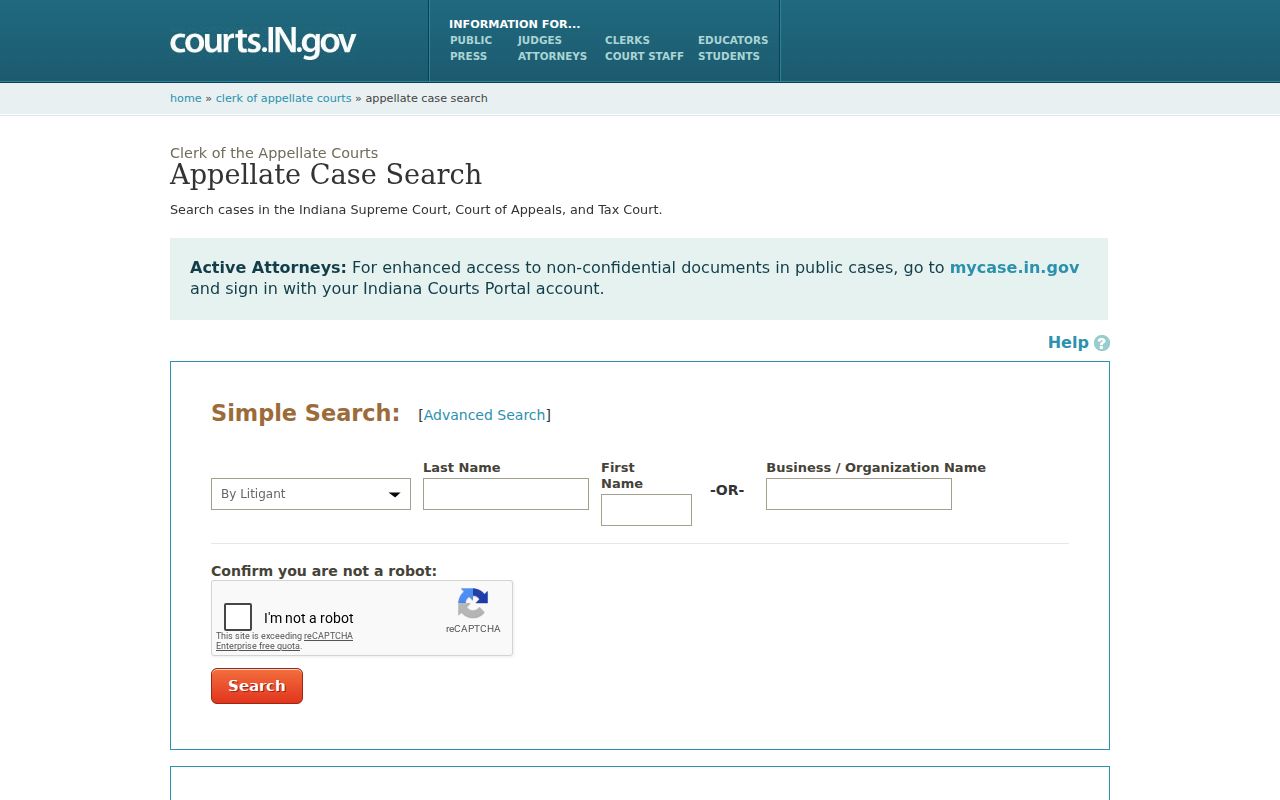
Because that search stands apart, it can link a trial cause number to appellate activity. Opinions and orders live in a separate decisions service. A docket search and an opinion search answer different questions.
Indiana's problem-solving courts are treatment and case-management programs inside local courts. They are not a new statewide docket portal. The directory of Indiana problem-solving courts lists certified and planning programs.
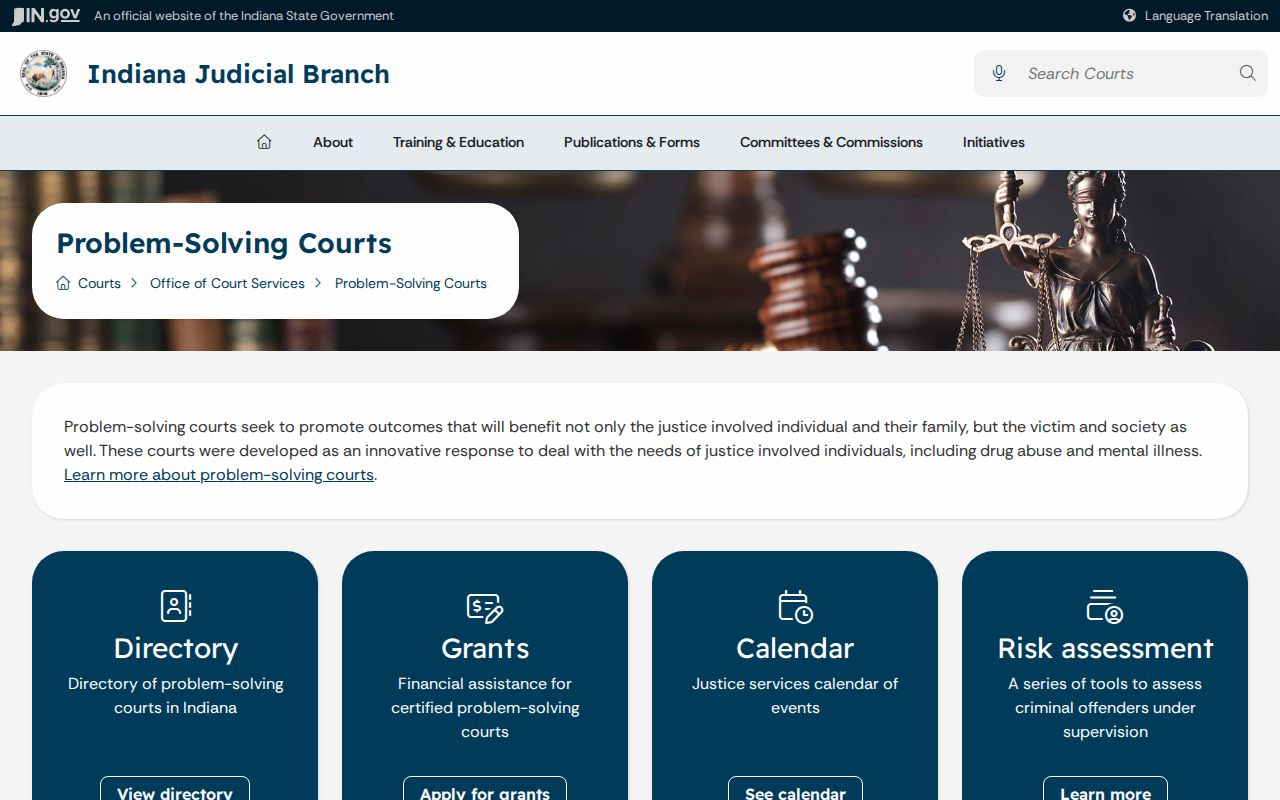
A participant's underlying case keeps its normal county case number. Public events may surface in MyCase, but treatment notes and clinical records are not ordinary public CCS content.
Indiana Court Docket Numbers: Read Rule 8
An Indiana case number tells you more than a count. Administrative Rule 8 breaks it into parts. There is a county and court identifier, the filing year and month, a case type, and a sequence. Take 55C01-1101-CF-000123. That string gives a court code, a January 2011 filing, a legacy criminal type, then a sequence. A MyCase search may run without the hyphens and leading zeroes. Copying the number exactly is the safest first try.
The first court code often signals the level. C means Circuit, D Superior, G a Superior Criminal Division, H City, I Town, J Probate, and K Marion township small claims. A transferred case can pick up a different prefix and number entirely. MyCase sometimes links prior number history. The clerk can still search an older cause when the online result comes up short. Check Indiana Administrative Rule 8 before decoding an unfamiliar prefix.
- CCS
- The Chronological Case Summary, Indiana’s official sequential record of court events.
- Case type
- An Indiana Rule 8 code for the legal category, such as CM, IF, OV, PL, or SC.
- Converted event
- An Indiana record imported from an earlier court system, not necessarily a new filing.
- RJO
- Indiana’s Record of Judgments and Orders, a clerk record series associated with the case file.
Rule 8 standardizes case codes, yet Indiana publishes no official statewide glossary for every CCS event abbreviation. Entry wording can vary by locality. So read the full event and any linked order; a short label may not carry one statewide meaning.
What an Indiana Court Docket Shows
An Indiana CCS is a dated list of court events, not a hearing transcript. It can name parties, counsel, costs, filings, orders, rulings, and judgments. Still, an entry may have no scanned document behind it.
| Case number | Indiana Rule 8 identifier for county/court, filing month, case type, and sequence. |
|---|---|
| Parties and counsel | Indiana case caption and the parties or attorneys appearing in the matter. |
| CCS entries | Dated Indiana descriptions of filings, hearings, orders, rulings, and judgments. |
| Settings | Indiana scheduled event and later reset or continuance entries; confirm the latest notice. |
| Public receivables | Fees, costs, credits, and payments recorded on an Indiana case; totals may lag. |
| Disposition | Recorded outcome of the Indiana case or a charge; read the judgment for the official result. |
Indiana Trial Rule 77 treats the CCS, the case file, and the Record of Judgments and Orders as three different things. A document matrix decides which images MyCase displays. If a paper is missing online, ask the Indiana clerk how to inspect or copy it.
Note that naming the exact Indiana document helps the clerk. Its filing date does too. That helps separate a CCS entry from the paper or recording you actually want.
A CCS Is the Indiana Docket, Not the Entire Case File
The Indiana Chronological Case Summary is the official list of judicial events. It is not the whole file. The clerk's file holds the pleadings, motions, service returns, orders, and judgments. Entered rulings sit in the separate Record of Judgments and Orders. A CCS line can name a filing whose PDF never makes it online.
A MyCase printout is not a certified record. Any transcript comes from the assigned court reporter. The county clerk can tell you whether a missing public filing is electronic, on microfilm, or in an older paper file. When you need authentication, request a certified copy. Indiana Trial Rule 77 describes the clerk's records in full.
Indiana Public Access to Dockets
Indiana court records are open as a general rule, with exclusions tied to specific records. The Access to Public Records Act supplies the public-record authority. Supreme Court rules govern the court files themselves. MyCase searches nonconfidential cases with no account needed. Its document matrix may display only some filings. For an official copy, go to the court or clerk holding the Indiana file.
Indiana access rules:
Indiana Code 5-14-3, the Access to Public Records Act, provides general public-record authority while recognizing the Supreme Court’s control over court-record access.
Indiana Access Rule 4 sets the general public-access presumption and requires a public indication when a record is withheld where the rule applies.
Indiana Access Rule 5 lists confidential whole cases and documents, including protected juvenile and mental-health records and personal identifiers.
Indiana Administrative Rule 9 governs remote and courthouse access, public daily calendars, fees, and bulk-data requests.
Some Indiana cases stay partly out of view. A public case can hold one protected document, and whole confidential categories never appear on a docket at all. Expungement can change what the public sees too. So a missing result may simply mean the law keeps that record closed, and its absence tells you nothing about what it contains.
Indiana MyCase, E-Filing, and Court Calendars Serve Different Jobs
Indiana runs three separate services, and each does a different job. MyCase handles the docket search, pulling up available case history. The E-Filing Manager and its approved providers send submissions into local case systems. Indiana Trial Court Calendars lists hearings for courts that opt in. Two cautions apply here. E-filing a document does not make it public. A calendar row is not the full CCS.
| Service | Purpose | Record limit |
|---|---|---|
| Indiana MyCase | Public search by case, party, or attorney | Participating Odyssey courts and records allowed for public viewing |
| Indiana E-Filing Manager / EFSP | Submit and serve filings | Not a public case-history search |
| Indiana Trial Court Calendars | Find published hearings by court, date, or case detail | Only opt-in courts and listed public settings |
Federal cases in Indiana follow a different track entirely. Those courts rely on PACER and CM/ECF rather than MyCase. The PACER public search service describes how to reach federal dockets.
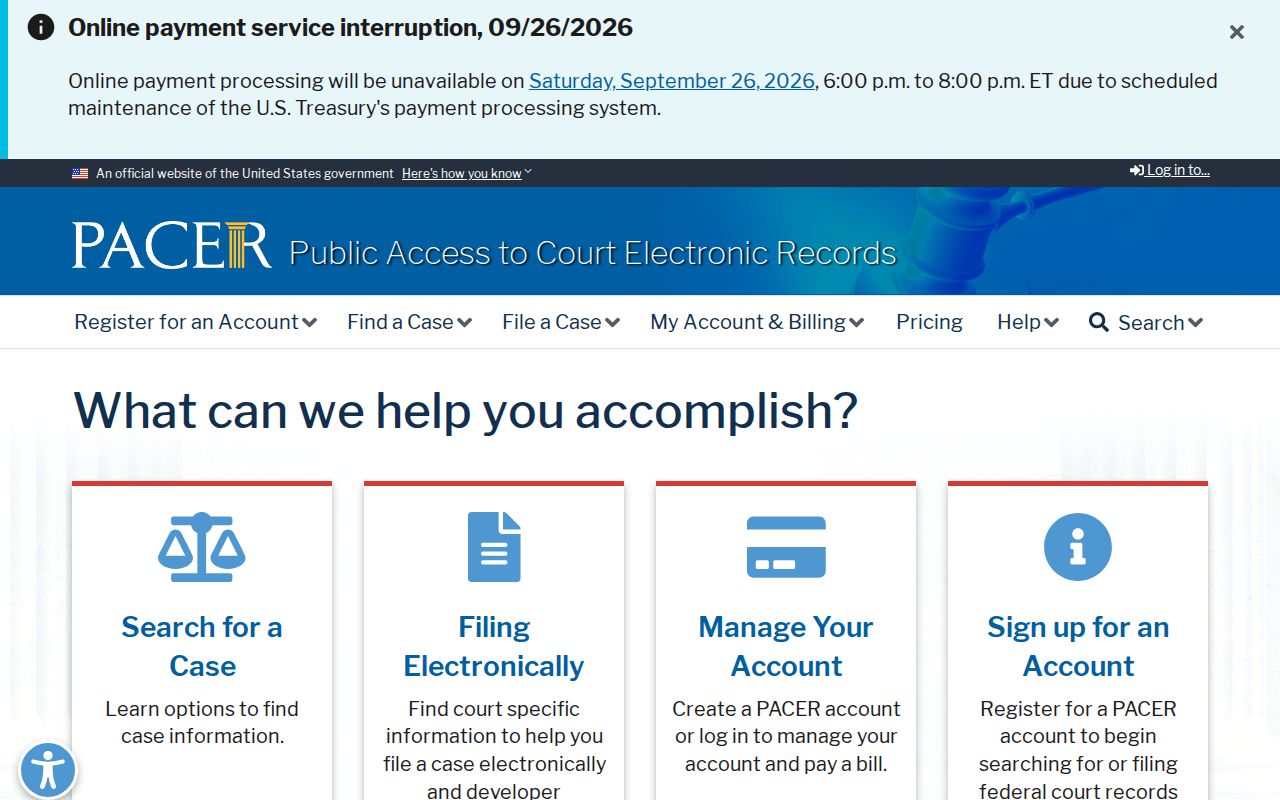
For a U.S. District or bankruptcy case, use the federal tools. Indiana trial files stay with the state courts. Appeals run through the Indiana appellate search. The forum printed on your papers tells you which docket to search.
Note: An Indiana e-filing notice only shows submission status. Public display still depends on the court record and the access rules that govern it.
How Indiana Courts Moved from Paper to Odyssey
Indiana’s push to connect its courts started in 2002. After a revised procurement, the Supreme Court picked Tyler Technologies’ Odyssey. Deployments began in 2007, moving court by court. A 2012–13 report counted 168 courts across 46 counties on the system by 2013. The Tax Court joined in 2014. The Supreme Court and Court of Appeals followed in 2015.
That staggered rollout explains a lot about Indiana docket search results today. Courts joined at different times. Entries can mix current filings with converted events or skip older material entirely. Conversion never guaranteed that every paper or image made it in. The statewide Odyssey overview describes the implementation in detail.
The Indiana Office of Judicial Administration supports the shared technology. Local courts create the events. County clerks keep the official court records. MyCase, e-filing, and calendars remain separate tools. Check the court identifier on an entry, or ask the clerk, when older files are involved.
Indiana’s 2024 Court Caseload in Context
Indiana’s courts handle an enormous volume. The 2024 tally spans 92 counties. It counts more than 400 trial courts, more than 575 judicial officers, and 1,144,342 cases filed that year. Keep the scope straight. That total covers all courts in the report, not MyCase results or county Superior Court cases. No public portal exposes every entry in it.
The 2024 Indiana Judicial Service Report also records 1,218,658 dispositions and 1,620,116 pending cases at year end. Infractions made up a large share of those dispositions, alongside misdemeanor and small-claims matters. Each category carries its own court assignments and access limits.
The statewide total shows the scale behind local court dockets. It is not one court’s workload or record coverage. To move from the big picture to the record you need, rely on the case number and court name.
Note: The 2024 report is the most recent finalized statewide dataset. Newer provisional figures carry a different reporting status.
Court Dockets by County in Indiana
The court that heard a matter keeps the full county docket and case file. For Circuit, Superior, and Probate records, your first stop is the Clerk of the Circuit Court. Go to the clerk in the county where the case was filed. The county route also helps in another spot. A citation may belong to a separate city or town court. Every one of Indiana’s 92 counties has its own site below. Each adds county seat and local court context to guide your starting point.
Marion County
Indianapolis · State capital, with nine township small-claims courts.
Allen County
Fort Wayne · Major northeast hub with multiple Superior Court divisions.
Lake County
Crown Point · Northwest Indiana system with county and local courts.
Hamilton County
Noblesville · Indianapolis suburban courts and a commercial docket.
St. Joseph County
South Bend · North-central regional court hub.
Vanderburgh County
Evansville · Southwestern Indiana regional court hub.
Tippecanoe County
Lafayette · West-central court hub with local traffic-court routing.
Every one of Indiana's 92 counties has its own page here with local court docket details. Start with the directory of all 92 Indiana counties.