
Indiana Traffic Court Records
No single Indiana traffic court exists for the whole state. Each citation goes to the court with authority over the violation and the agency that issued it. Indiana State Police and highway tickets usually head to a county Circuit or Superior Court division. A city citation often stays in that local court. What the ticket alleges matters too. An infraction is filed on the civil docket. A misdemeanor traffic charge is a criminal matter. A local ordinance citation may carry an OV or OE designation. Indiana has no Justice of the Peace tier.
The court printed on the ticket tells you where the CCS and case file live. The Clerk of the Circuit Court keeps county Circuit and Superior records. City and town courts may run their own clerk offices. MyCase can display public cases from Odyssey courts. It is not a full statewide archive of citations. For county trial records, the Indiana County Directory connects you to the right clerk. A city ticket may mean contacting that city court directly.
A case number can hint at whether a matter is an infraction, a misdemeanor, or an ordinance case. The issuing court remains the best first clue. One clean search does not prove a ticket was never filed somewhere else.
How Indiana MyCase Finds a Citation
MyCase is Indiana's main statewide public case search for eligible citations in Odyssey courts. Open Case search and type the citation number exactly as printed. Indiana citation numbers follow no uniform format. Keep the prefix and any leading zeroes. If the number brings back nothing, try the Rule 8 case number or a party search. Then check the court and county shown in the result.
Public case search on MyCase is free, with no account needed. Not every court fits the picture. Some city and town courts skip Odyssey, and older records or documents may never appear online. Check the roster of participating court identifiers first. A blank result does not mean no case exists. For a court outside the system, call the court on the citation. Ask its clerk to search locally.
One caution: searching MyCase is not paying a ticket or entering a plea. A public result may show case events and a balance. That balance can lag behind reality. The Indiana court clerk holds the current amount and the official disposition.
Indiana Citation and License-Hold Systems
Several services surround a traffic case in Indiana. MyCase searches the court case. ePay finds and pays eligible tickets only. The Electronic Citation and Warning System moves citations from law enforcement into court systems. The Indiana Bureau of Motor Vehicles keeps a separate driver record. A court's failure-to-appear or failure-to-pay notice can affect driving privileges. No single public license-hold lookup covers every citation.
| System | What It Holds | Run By |
|---|---|---|
| Indiana MyCase | Public case and citation records from participating Odyssey courts | Indiana Judicial Branch |
| Indiana ePay | Search and payment for eligible tickets; not every ticket is payable online | Indiana Courts payment service and participating courts |
| Indiana eCWS | Electronic citation and warning data sent into a local court system | Indiana Office of Judicial Administration and law enforcement |
| BMV Driver Record | Driving history and court-reported violations or suspensions | Indiana Bureau of Motor Vehicles |
| Court / local clerk | Official CCS, case file, hearing, payment, and disposition | County or local court |
The Indiana eCWS workflow carries citation data to the receiving court. It serves agencies, not the public. There is no search page. Odyssey can also send certain CDL violation details to the BMV. That transfer still leaves the driver record different from the court docket.
Indiana ePay Does Not Cover Every Ticket
Indiana's ePay page searches by ticket number. It also takes a driver's license number or a name and date of birth. Enter the ticket number exactly as printed. Include the prefix and leading zeroes. A result can be paid online only if that court and ticket type participate. The ePay app has no county or court dropdown. It can't reach every local docket directly. The Indiana ePay ticket service lays out the lookup choices it accepts.
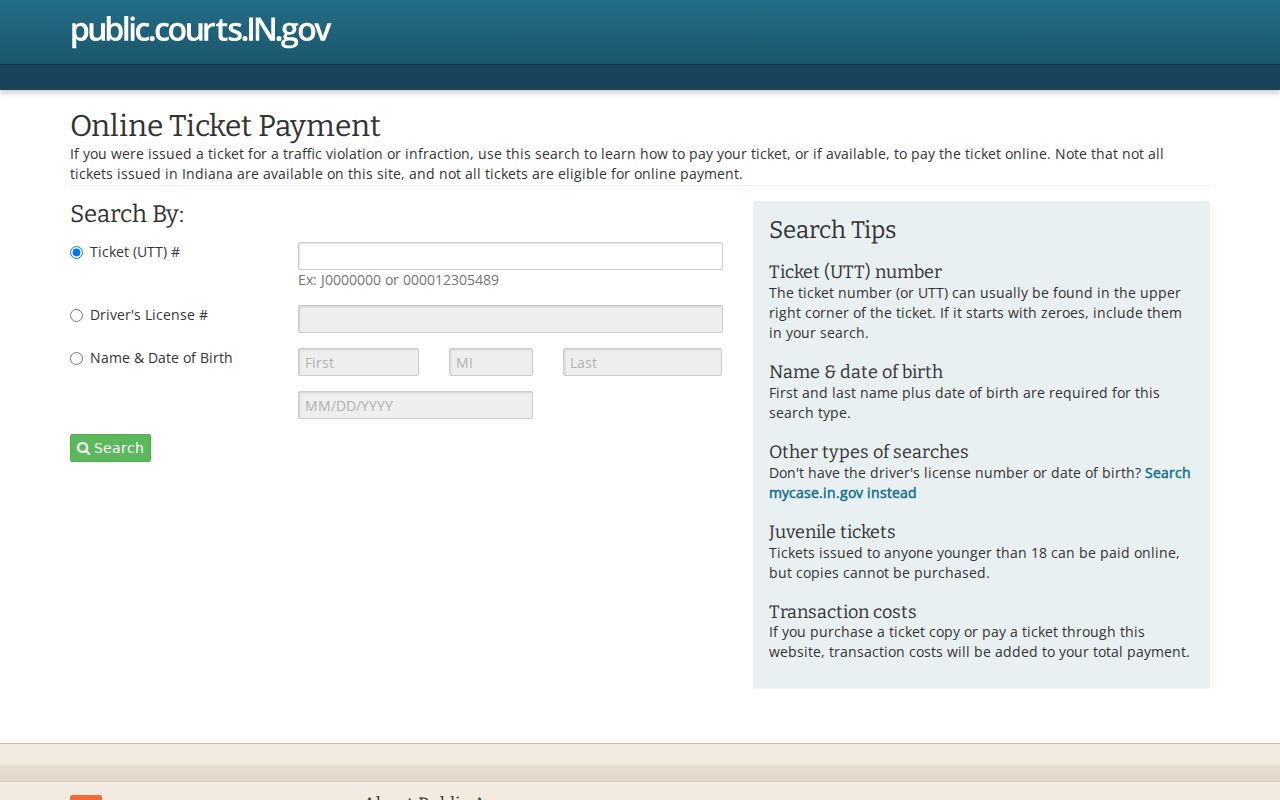
When ePay finds no ticket or marks one ineligible, follow the instructions on the citation. Contact the court that received it. Paying online is a transaction. It is not a court-record search, and it is no way to enter a denial. Keep the receipt, then confirm the court's CCS shows the payment and the final disposition.
Note: The ePay page displays any transaction charge for that court or processor. No uniform statewide convenience amount is published.
Looking Up an Indiana Traffic Ticket
Identify the court before anything else. A citation number on an Indiana ticket may differ from the later Rule 8 case number. A ticket can be civil, criminal, or an ordinance matter. The issuing court decides which clerk holds the local record. Search by a known number first. Then narrow name searches with court or filing-date filters where they exist.
- Read the Indiana court name and county printed on the citation; for a city or town ticket, note that local court too.
- Search Indiana MyCase by the UTT or citation number, preserving letters and zeroes. If needed, try a case number or party search.
- If the case is public and payable, check Indiana ePay separately. An ePay result does not replace the CCS or confirm a contested hearing.
- Use the Indiana County Directory to reach the county clerk, or call the city or town court that issued the ticket.
- Check the newest Indiana CCS entry for a setting, order, or payment, then confirm a near-term date with the assigned court coordinator.
MyCase caps its search results at 1,000 and may throw up a CAPTCHA after repeated searches. Too many hits? Narrow the docket search by court or filing date. If the court is not on Odyssey, the local clerk is still where the ticket record and hearing details live.
A Missed Indiana Ticket Can Affect Driving Privileges
Skip a required appearance or payment. Indiana law lets the court report it to the BMV. A driving-privilege suspension can follow. It depends on the case and the notice sent. The court handles the ticket and reports its status. The BMV keeps the separate license record. One ordinary citation does not trigger a universal registration-renewal hold. The BMV's failure-to-appear and failure-to-pay information spells out how the court-reporting consequence works.
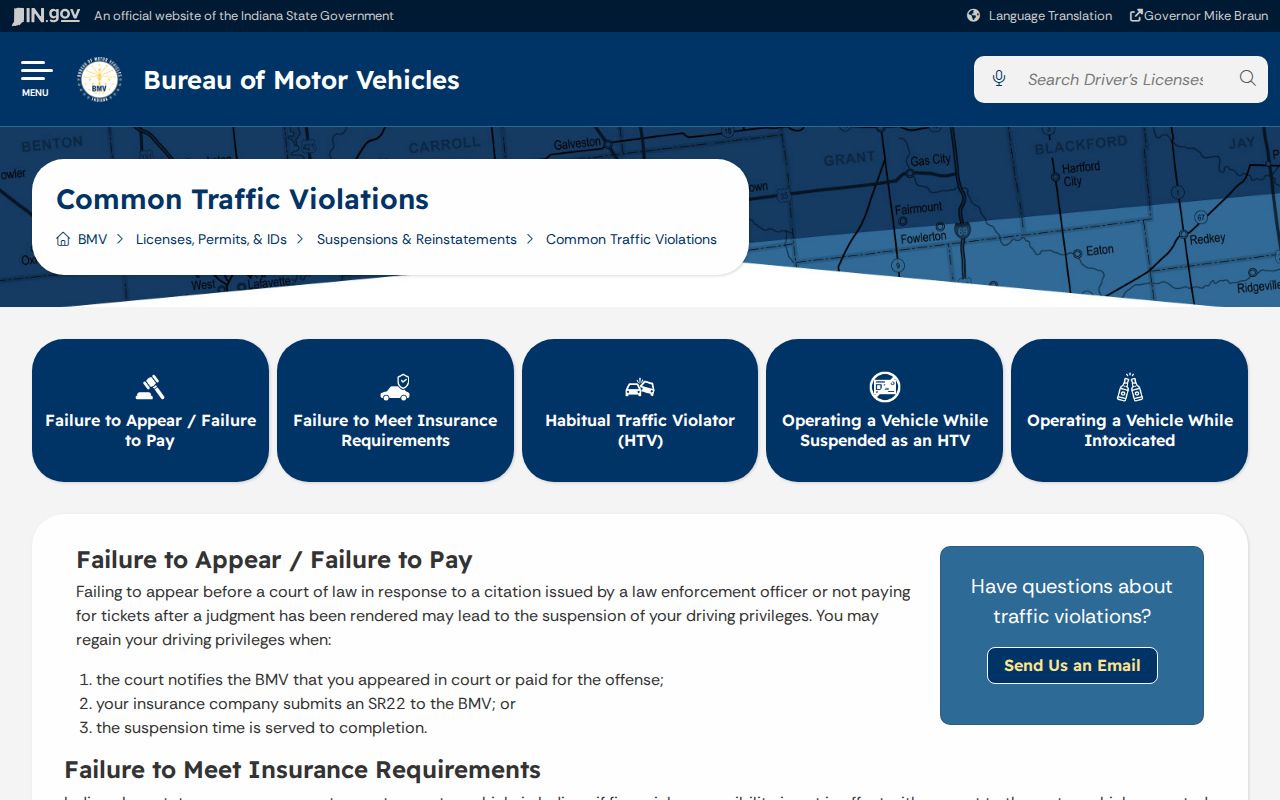
Call the Indiana court that issued the citation. Ask what appearance or payment it wants and whether it has sent a clearance notice to the BMV. The current Indiana BMV driver manual allows up to ten business days of processing after the agency receives court information. So a paid receipt or a changed MyCase screen proves nothing about the BMV record yet.
For license status, use the BMV service. For the case balance, hearing, or disposition, use the local court or clerk. Keep the two confirmations separate.
Note: An Indiana court's clearance report and the BMV's own driver record are separate. Confirm both after resolving a ticket.
Paying or Fighting an Indiana Ticket
On an Indiana traffic docket, paying and contesting a citation are different choices. The ticket itself prints the response deadline and directions. Read it closely. Indiana has no single statewide deadline or online channel for every local court. Do not assume a class or payment plan exists. Ask the court that issued the citation about a local deferral program.
| Pay an eligible Indiana ticket | Contest an Indiana citation |
|---|---|
| Pay the amount shown through an Indiana court-approved channel; payment ordinarily resolves liability under the applicable infraction process. | Follow the Indiana citation’s denial or appearance instructions; the court sets a hearing or trial. |
| Check the Indiana court’s deadline, amount, and any processor fee before paying. | Meet the local response deadline and ask the Indiana clerk about forms or accommodations. |
| Save the receipt and verify the case status with the court. | Confirm the assigned court and current setting with its coordinator. |
Missed date or payment: On an Indiana ticket, a failure to appear or pay can lead to a driving-privilege suspension after court reporting to the BMV. Contact the court that owns the ticket to resolve the case, then confirm the separate license status with the BMV.
Indiana Code 9-30-3 covers the court-to-BMV reporting process. How long a suspension lasts, and what releases it, depend on the matter and the order. The court explains the case requirement. The BMV confirms its own record and any reinstatement step.
Indiana Ticket Deferrals Depend on the Local Court
Indiana law lets local prosecutor or court programs handle some traffic matters. There is no uniform statewide deferral price. There is no guaranteed eligibility rule either. A city or county program sets its own screening criteria, class, payment, or dismissal terms. The citation's court and the local prosecutor decide whether the option applies. Ask the Indiana court for the terms in writing. Do not treat a ticket as delayed or dismissed before that. Keep the original response deadline in view until the court confirms an agreement.
A diversion or deferral entry may show up in an Indiana CCS. It does not create a statewide online program search. For a program question, start with the court or prosecutor printed on the citation. The Indiana county directory helps route a county matter. Local city and town courts can have their own clerk and procedure. The governing infraction provisions appear in Indiana Code Title 34, including Chapter 28-5.
Note: Indiana has no statewide deferral search. Ask the local court or prosecutor for written terms before the response deadline.
Indiana Court Record vs Driver Record
An Indiana traffic case and a driver history are two files. Different agencies hold them. The court CCS shows the citation, case events, hearing settings, payment, and disposition. The BMV record tracks driving history plus court-reported violations or suspensions. Each file answers a different question. A MyCase result cannot replace an official driver record. Nor can the BMV record replace a certified court copy.
| Record | Court citation / CCS | Indiana driver record |
|---|---|---|
| Custodian | County Clerk of the Circuit Court or local city/town court clerk | Indiana Bureau of Motor Vehicles |
| Shows | Citation, plea, court event, setting, payment, and disposition | License and driving history, court-reported violations, or suspension status |
| Public route | Indiana MyCase if the court participates; otherwise the issuing court or clerk | BMV driver-record service for the subject’s own record |
| Certified record | Ask the court clerk for a certified copy | Certified Official Driver Record is $4 through the BMV |
The Indiana BMV offers a free Viewable Driver Record online and a certified Official Driver Record for a fee. Its Indiana driver-record service explains the subject-access routes.
An Indiana BMV driver record is not a public court docket lookup. Even after a court case is paid or resolved, the BMV status can lag behind the court's reporting. So verify the disposition with the court and the license status with the BMV.
Indiana Safe Zones Use a Limited Work-Zone Pilot
Indiana runs no broad statewide red-light or speed-camera docket. The INDOT Safe Zones program is a limited work-zone speed-enforcement pilot created by 2023 legislation. Workers must be present. A vehicle must also exceed the posted limit by at least 11 miles per hour. Program materials describe a warning for a first violation, then civil penalties for later ones.
A Safe Zones notice is not automatically a routine police-issued infraction on MyCase. The notice itself states the review and payment route. Check the INDOT Safe Zones program for current sites and instructions. Do not assume every notice enters a county court docket. Note: Whether a work-zone notice appears in a court record depends on its legal route; the notice itself controls where to respond.
Indiana Infractions Form a Major Case Stream
Indiana courts handle a huge volume of minor matters. Traffic tickets and ordinance cases fill dockets across the state. The 2024 Indiana Judicial Service Report counted 330,943 infraction dispositions statewide. That number covers completed cases within the report's scope. So it is not a tally of tickets you can pull up in a docket search today. Some citations never enter the statewide index at all. Local courts process them on their own terms, and access to case types varies by court.
A single Indiana ticket matters more than the statewide figure. Start with the court printed on the citation, not a number. Search the exact citation or cause number in a docket search. Confirm you have the right court. Ask the clerk if a result or payment entry is missing from the record. The big total does explain one thing: citation records, court dockets, calendars, and BMV systems in Indiana stay separate because the volume is simply too large for one system to carry.