
Court Calendars in Indiana
Indiana trial courts schedule hearings on their own cases. Two documents matter here. A court calendar is a public schedule of sessions. The Chronological Case Summary (CCS) is the running record of events in the case itself. Indiana MyCase may list a hearing notice in that history. Still, when a date changes, read the newest CCS entry or order rather than trusting the calendar alone.
Each court decides how to publish. Some Indiana courts post a public daily docket. Some hang a calendar at the courthouse, and some share a schedule through the state Trial Court Calendars app. County clerks keep most Indiana trial-court records, but the assigned court controls its own schedule. City and town courts may handle local arrangements differently. When details seem off, call the court or its coordinator to confirm the current court date.
Indiana’s Optional Trial Calendar
Indiana's Trial Court Calendars app is a daily schedule. It is not a full statewide docket. Courts decide whether to publish through it. Only public matters a court releases will appear. The search form lets you narrow by county, court, date, case name, or case number. Which courts show up depends on the county you pick. A broad query stops at 100 results. A case number or court name helps focus the list.
The menu itself carries clues about coverage. On September 25, 2026, it offered 54 county choices and 182 court-selector values. Those lists are live metadata, so participation can shift. One selector value was even labeled abolished. That means a menu entry alone does not prove a court still holds hearings. The app's rolling date window moves too. When a date falls outside it, use Indiana MyCase. The assigned court's local calendar is another fallback. So is its public counter.
The official Indiana Trial Court Calendars search is the public search surface for this daily court docket schedule.
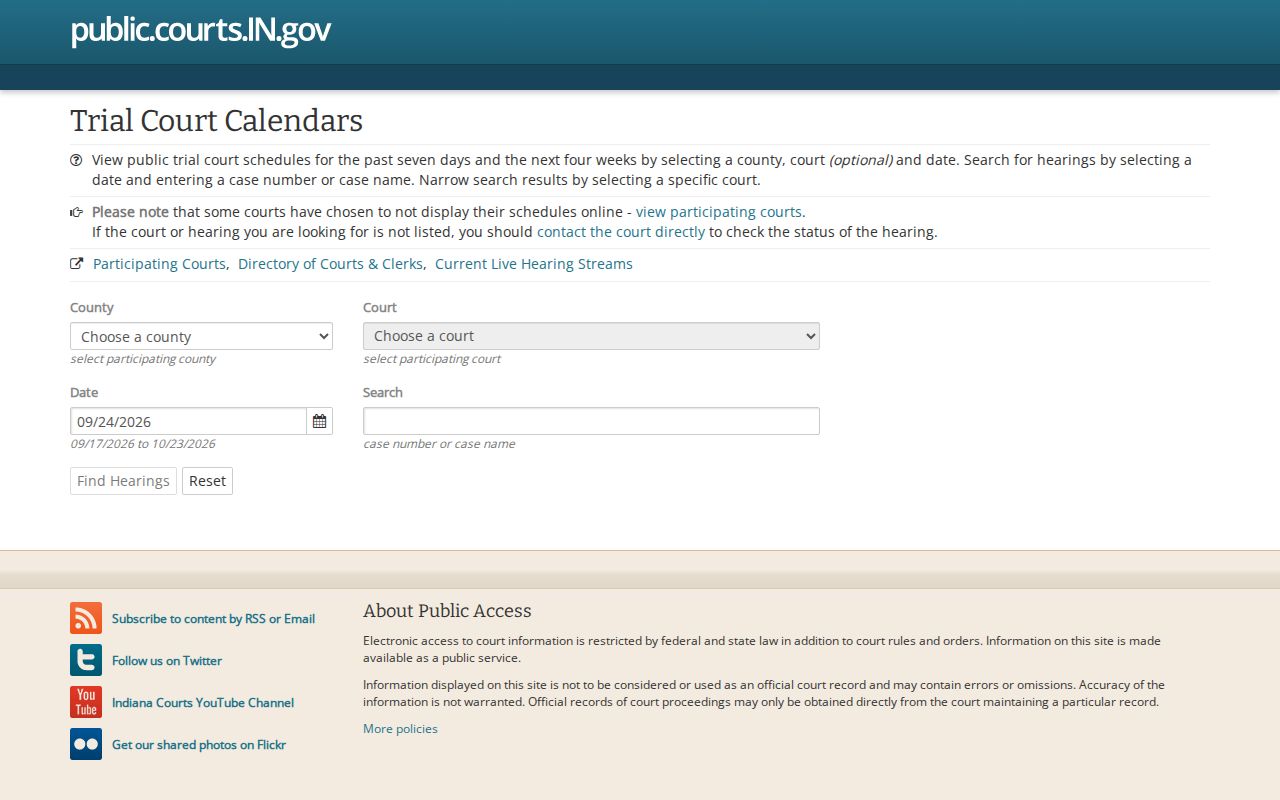
Participating courts publish their hearings here. Coverage differs from MyCase's statewide case search, so an empty result should send you to the CCS and the local court.
Note: Participation is court by court. A missing event may just mean the court opted out, or the hearing sits outside the app's rolling date window.
Finding an Indiana Court Date
Identify the right court through the statewide case record first. Then verify the setting locally. Indiana MyCase searches by case, party, or attorney. A party or citation search works when the cause number is unknown. The case number and court shown in the result are the best starting points for the calendar search. An Indiana case may never show up online. The issuing city or town court may keep its own records contact.
- Search MyCase by case number, party, or citation. Open the matching case and confirm its county and court.
- Read the newest Indiana CCS events for a hearing notice, order, continuance, or reset. Open a linked notice or order when available; older dates remain in the event history.
- Search Indiana Trial Court Calendars by county, court, and date, or add the case name or number. For the court’s local page or online docket, use the Indiana county directory to reach the right county.
- If the app has no result, check an Indiana court’s paper or posted daily docket, courthouse calendar, or public terminal. A court may publish in another format or may not participate in the app.
- Call the coordinator or calendar clerk for the Indiana court about a changed or near-term setting. The county clerk can help identify the court and contact path; a City or Town case may require its local clerk.
- For an Indiana appeal, check the appellate CCS and argument schedule. Oral argument is discretionary, not a routine trial hearing.
Sometimes a phone call beats a docket search. When an online court date is missing, unclear, or close at hand, call the courthouse counter. Ask which setting is current. Ask whether a new notice was issued, and where remote-hearing instructions are posted. Hours and contact methods vary across Indiana. Check the court directory or the court's own site before you visit.
MyCase and CourtCal Serve Different Jobs
Indiana offers two public tools. They do different jobs. MyCase is built around the case and its CCS. Trial Court Calendars is built around the sessions participating courts publish. A courthouse posting or local daily docket may present schedule information in yet another format. Checking one Indiana source does not mean the others hold the same dates or documents.
| Source | Main use | Limit to remember |
|---|---|---|
| MyCase CCS | Indiana case-specific event history, notices, and some linked orders | Not every court, historical record, or document is online |
| Trial Court Calendars | Daily Indiana sessions from courts that opt in and publish public matters | Not every county or court participates; broad searches have a result cap |
| Local daily docket | Indiana public calendar in an electronic or other local format | Posting methods and detail vary by court |
Indiana's Administrative Rule 9 requires courts to make daily calendars or dockets public, electronically or otherwise. The rule does not turn the app into a complete statewide schedule. You may know the case, but the calendar service shows no entry. Use the county-level route.
Note: Rule 9 guarantees a public daily calendar in some available format. The optional app is just one channel.
Reading an Indiana Court Setting
A court setting usually names the case, date, time, court, and event. Exact labels vary with the court and the calendar format. Indiana Trial Court Calendars shows the session date and time, case number and style, court name, hearing description, and judicial officer when supplied. Its row template has no separate courtroom field. Indiana Rule 9 calls for a public daily calendar to list the case number or caption, date, time, and location. So a local posting may carry location detail the app leaves out.
| Case Number | The Indiana case identifier; the app may link it to the public MyCase record. |
|---|---|
| Date and Time | The session date and start time; an end time or time zone may also appear. |
| Court and Location | The assigned Indiana court and any posted room or location. The calendar app may not show a separate room field. |
| Hearing Type | The local Indiana event description, such as a status conference, motion hearing, or trial. |
| Judicial Officer | The judge or judicial officer, when the publisher supplies a name. |
In Indiana, the date sits next to the event label on the docket. So read that pairing instead of guessing from a general case status. Courtrooms are sometimes left off the calendar. When that happens, check the Indiana court's daily posting. Or ask the coordinator where to appear. Juvenile entries may hide party names, and a name that is missing does not mean no hearing was ever scheduled.
Indiana Hearing Labels Vary
Indiana does not use one statewide menu of hearing labels. Each court docket picks its own descriptions. So the same stage of a case can carry a different name in a local calendar. Terms on an Indiana court docket are a starting point only. The assigned court's rules and its notice control what a setting actually requires of you.
- Initial hearing
- An early court appearance; the notice gives the date and any appearance instructions.
- Status conference
- A check on case progress, not necessarily a trial or a final ruling.
- Motion hearing
- A setting for the court to consider a request for an order.
- Continuance
- A court-approved postponement that moves a hearing or trial to a later date.
- Reset
- A local calendar term for a matter receiving a new scheduled date; confirm the latest setting.
Other Indiana labels cover arraignment, pretrial conference, sentencing, eviction hearing, small-claims hearing, and jury trial. Those settings do different jobs. A jury-trial date decides the case; an argument or status setting just moves it along. Check Indiana's local rules and the actual notice. They say whether you must attend, appear remotely, or file something first.
Indiana Resets and Continuances
Indiana courts move hearings all the time. When that happens, the older date can still sit in the Indiana CCS. That is because the summary lists every event in order. So scan for a continuance motion or order. Also look for a reset entry and a fresh hearing notice. Start with the newest Indiana notice you can find. If a date is disputed or coming up soon, confirm it with the assigned court. An old calendar row that lingers in a search result is not proof of anything current.
A canceled setting, a postponed hearing, and a dismissed case are three different things. A continuance only shifts the schedule; it settles no claims and no charges. Indiana's Trial Rule 77 requires prompt CCS entries. Those entries give dates and short descriptions of judicial events or orders. The appellate docket reader guide notes that older and newer Indiana appellate CCS layouts can show an event date and a recorded-entry date differently. So compare the entry text and any signed order. Do not trust a date label by itself.
Note: If an Indiana event was continued, rely on the later order or notice for the new date. The old calendar row stays in the history.
Indiana Calendar Rows and Location
The daily calendar's location field tells you where the matter will be heard. Indiana's Trial Court Calendars app packs this into a compact row. Administrative Rule 9 sets out what a public daily calendar must contain. Local postings sometimes add detail the app leaves out, like the room or division. So check both when the venue matters.
| Calendar Detail | Indiana Trial Court Calendars Row | Indiana Public Daily Calendar |
|---|---|---|
| Case | Indiana app’s case number and style | Indiana public calendar’s case number or caption |
| Date and time | Session date and start time; end time or time zone may appear | Date and time |
| Location | No separate courtroom field in the inspected Indiana row template | Location is part of the required Indiana daily-calendar information |
| Court and officer | Indiana court name and judicial officer when supplied | Local posting format may provide added detail |
Room and division details may surface in a local calendar or a PDF. They can also appear in a courthouse posting or a court notice. A setting that names the court but not the room deserves a local check. That matters most in a building with several courtrooms. The coordinator or calendar clerk can confirm the location and tell you whether updated appearance instructions have been posted. Remote-hearing details also vary by court. Use the current notice rather than assuming the calendar row carries connection information. Indiana Administrative Rule 9 governs public access to daily schedules. It also spells out the required information.
Missing an Indiana Court Date
A missed hearing needs quick action. Call the Indiana court handling the case and ask what happened. Was the absence noted? Was a new date set? Is a signed order on file? The county clerk can point you to the right court and phone line. The judge, not the clerk, controls the docket. For a city or town case, check with the local court clerk first. If you have a lawyer, tell that office right away. Follow whatever instructions the court has posted.
What comes next depends on how the court responded. The missed setting may have generated an order or docket entry. That entry may never appear in the calendar app. So pull the most recent CCS events. Request the signed order when one is available. Never assume the case was dismissed. Never assume no further appearance is required. A docket entry alone tells you what was filed, not how the judge ruled.
If You Missed a Setting:
Call the assigned court coordinator or clerk and ask for the current case status, any order, and the next required appearance.
Ask whether the court recorded the missed appearance, entered an order, or set another hearing. The next step depends on the case and that order.
Use the newest notice or court instruction to confirm the next date and location; an old calendar entry is not confirmation of a reset.
Indiana Appellate Argument Dates
Appeals in Indiana mostly move on paper. Briefs and written decisions carry the load. Oral argument happens only when a panel asks for it. An appellate docket therefore looks nothing like a daily trial calendar. When argument is set, the appellate CCS is the first place to check. The court's own argument schedule or streaming page is the other. A trial-court docket will not show that event.
An appeal also opens a second case history. The trial court keeps the original CCS. The appellate docket collects the filings and events at the higher court. Confused by a case number or a hearing entry? The Indiana Appellate Clerk handles record routing for the Supreme Court, the Court of Appeals, and the Tax Court. Trial settings in the counties still must be confirmed with the trial court that set them.
Note: Indiana Appellate Rule 9 generally gives parties 30 days after final judgment to file a notice of appeal. Exceptions and other timing rules can apply.