
Searching Criminal Dockets in Indiana
MyCase is where an Indiana criminal docket search usually starts. It covers public cases in participating Odyssey courts. Think of it as one portal with several paths rather than a criminal-only database. A search can return the Chronological Case Summary, or CCS. That CCS is the court's running log of filed events and judicial actions.
The full case file never travels. It stays with the court that heard the charge. Each county's Clerk of the Circuit Court keeps the Circuit, Superior, and Probate records. A City or Town Court may hold its own. Search with a case number or the name from a notice, and name the court if you can. When MyCase lacks a case or a paper, the county directory points to the right clerk.
- Open Indiana’s MyCase and choose Case, Party, or Attorney search based on the information available.
- Enter one case identifier, or search a person by last name and at least one of first name, middle name, or date of birth.
- Choose an Indiana court and criminal case type if useful, then narrow by status or filing-date range.
- Confirm the court and follow the county or local clerk route for the Indiana CCS and any public filing not linked online.
- Ask the Indiana court’s record-holding clerk for a plain or certified copy; confirm the current fee and delivery choices locally.
Search Indiana Criminal Cases in MyCase
MyCase offers Case, Party, and Attorney search modes for public criminal cases and more. The case mode takes one number at a time. A person search needs a last name plus a first name, middle name, or date of birth. Businesses get their own field. Attorney lookup works with a bar number or a last name paired with a first or middle name. The official Indiana MyCase Search Tips page spells out every field combination.
Filters narrow an Indiana docket search by participating court, criminal category, open or closed status, and a filing-date range. That date range can be one-sided or two-sided. A trailing asterisk matches names beginning with your text. But it cannot pair with sounds-like matching. Results cap at 1,000, so tighten broad searches by court, date, or name. Repeated searching can trigger a CAPTCHA. The search is free and anonymous. Older data and document links vary by court and date.
The public Indiana MyCase search page lays out the Case, Party, and Attorney routes for public criminal dockets.
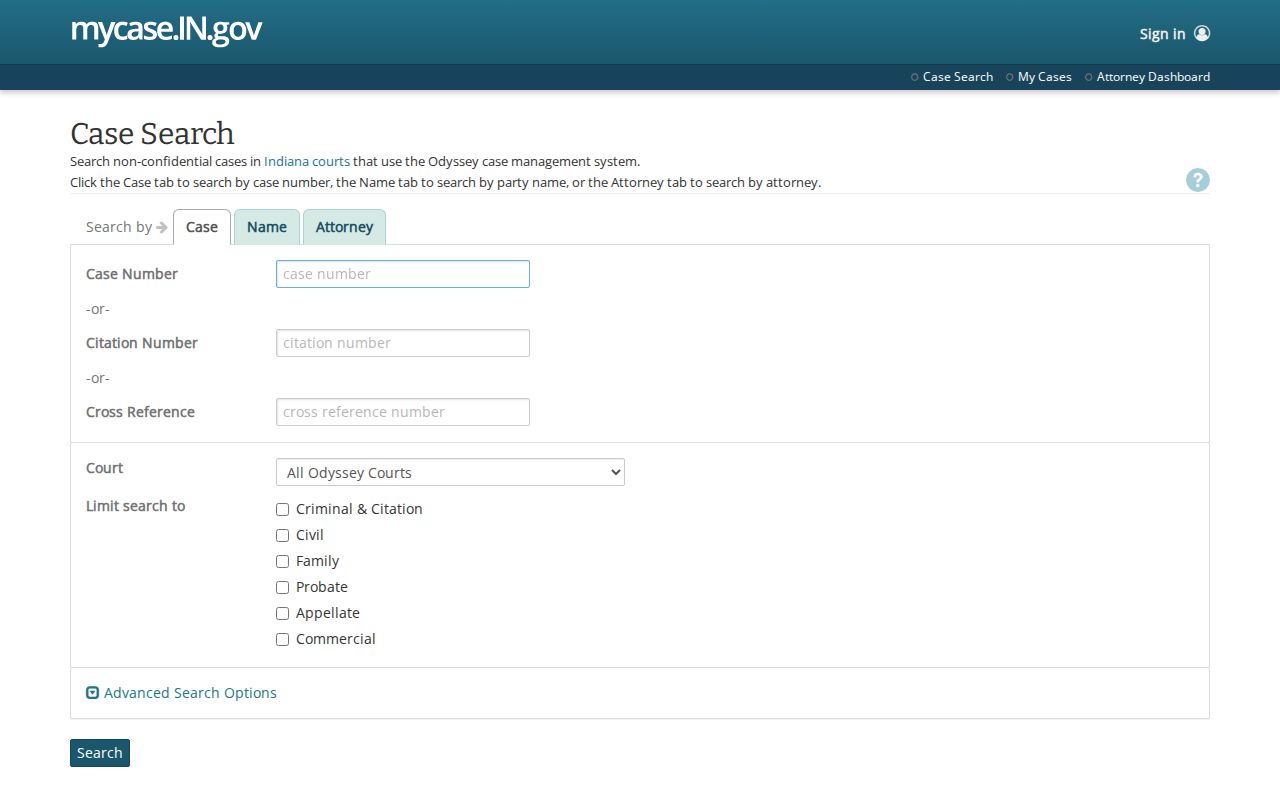
Finding a case record is what these search modes do. They do not promise that every court, event, or document image appears online.
Note: Indiana party searches can miss a case when DOB is added because many civil and some criminal records lack that field.
What an Indiana Criminal Docket Shows
The official event history in an Indiana trial court is the Chronological Case Summary. Under Indiana Trial Rule 77, the CCS records the case title and number, attorney or self-represented party details, public receivables, event dates, and short descriptions of filings, orders, rulings, or judgments. The case file itself holds the charging papers, motions, service returns, orders, and sentencing records. MyCase may link some of those papers. Even so, a CCS entry does not guarantee a downloadable image.
| Case Number | Indiana Rule 8 groups the court and county identifier, year and month, case type, and sequence. Example: 55C01-1101-CF-000123; CF is a legacy felony code. |
|---|---|
| Charge | An Indiana charging event may identify the alleged offense, felony level or misdemeanor type, and cited statute. A charge is not the final finding. |
| Parties and Counsel | The Indiana case caption names the defendant; attorney appearances and self-represented status may appear in the record. |
| Events and Settings | Indiana CCS entries may show an initial hearing, release or bond order, motions, pretrial settings, trial, and later court action. |
| Plea and Judgment | A plea, verdict, disposition, and sentence are separate points in the history. Read the signed Indiana judgment or sentencing order when available. |
Indiana Criminal Case Codes
Every Indiana cause number carries a short case-type code under Indiana Administrative Rule 8. The code classifies the case when filed. It does not announce what the court later found. Before opening the CCS, the code helps separate matters. It can tell a criminal prosecution from an infraction, an ordinance matter, or a post-conviction petition. The current list appears in Administrative Rule 8.
- F1–F6
- Current felony-level case types for offenses dated on or after July 1, 2014.
- CM
- Misdemeanor case type. The level in the cause number does not by itself establish the eventual outcome.
- IF
- Infraction case type, including many traffic matters that are civil violations rather than criminal convictions.
- OV and OE
- Ordinance and exempted ordinance case types, often tied to a local charging authority.
- CF and FA–FD
- Older felony codes that may remain in historical cause numbers; no new CF numbers were assigned after 2001.
A court identifier also sits inside the case number, ahead of the date and type fields. Transfers can change that identifier. MyCase may still keep the number history. Indiana publishes no single statewide codebook for event descriptions or outcome labels, so read the event text and the signed order rather than treating local shorthand as a uniform status code.
Note: Indiana F1–F6 codes apply to offenses dated on or after July 1, 2014; older files may retain CF or FA–FD labels.
Stages of an Indiana Criminal Case
A typical CCS opens with a prosecutor's information or a grand-jury indictment. It then logs the initial hearing and counsel status. The court may enter a not-guilty plea and set bond or other release conditions. MyCase is not a full bond ledger. Financial totals can lag, so confirm the current balance with the clerk. Motions, pretrial conferences, a plea, trial, judgment, and sentencing follow in later entries. The Indiana Criminal Rules govern those steps.
Not every Indiana criminal case walks the same road. Some end by plea, dismissal, diversion, or another early action. No trial is ever set in those cases. A hearing notice is not proof the event happened, since continuances and resets move dates. Watch the newest CCS entry and the order that controls it.
Typical Indiana docket flow: Charges Filed › Arraignment › Pretrial › Plea or Trial › Disposition › Sentencing
Indiana Criminal Problem-Solving Courts
Problem-solving courts in Indiana are local treatment and supervision programs inside the regular court system. They are not separate statewide criminal courts. The Indiana Office of Court Services directory describes certified and planning programs, including adult drug, veterans treatment, mental health, reentry, and domestic violence courts. Each local court sets eligibility, referral, and participation steps within state standards. The directory lists programs; it is not a second criminal docket search.
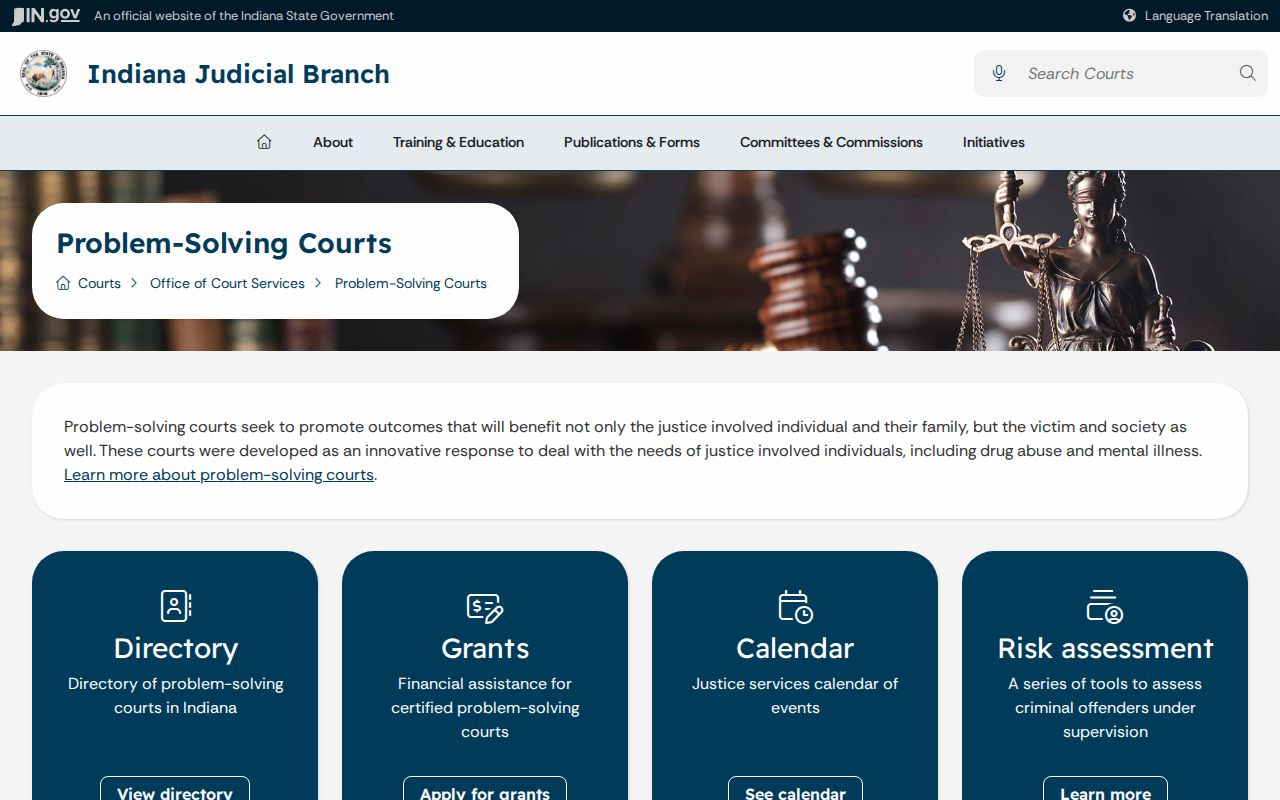
A problem-solving court label changes less than people assume. The Indiana case keeps its local cause number and its CCS. The public docket may show a referral or a status event. Treatment notes and clinical exchanges stay out of ordinary case entries. So the program itself does not make the Indiana case confidential. A public entry never exposes private treatment details.
Where Indiana Criminal Dockets Sit
Indiana county Circuit and Superior Courts share criminal jurisdiction, and local caseload plans assign cases under required criteria. So a felony is not automatically a Circuit case. A misdemeanor is not automatically Superior. To find the court holding the record, read the court identifier inside the cause number, the charging paper, and the county assignment information. Administrative Rule 1 supplies the statewide framework.
City and Town Courts handle ordinance cases plus statutory misdemeanors or infractions, but never felonies. Some keep separate files even when their cases appear in MyCase. Before assuming the county Clerk of the Circuit Court holds everything, check the Indiana issuing court; the county directory maps the route. For scale, Indiana’s 2024 Judicial Service Report counted 119,789 misdemeanor and 330,943 infraction dispositions in courts of record. Infractions are treated as separate civil violations. Those statewide totals say nothing about one court’s caseload. The 2024 report has the details.
Note: In Indiana, a City or Town Court appeal generally goes de novo to Circuit or Superior Court, creating a new trial-level case history.
When a Criminal Case Is Missing
A blank MyCase search does not mean no Indiana criminal case exists. Several things can hide a case. A City or Town Court may sit outside Odyssey. Older files can predate the online data. A transfer may change the cause number. Confidentiality, sealing, or expungement can also hide a case. A citation number may also differ from the number the court stores. Indiana’s Odyssey participation list lists court identifiers and start dates, so start there.
If a public case is missing: confirm the court and exact identifier on the citation or notice, try the current case number and any prior number, then contact the clerk for the court that received the charge. Ask whether the record is outside online coverage or excluded by a rule or order.
For a county Circuit or Superior Court file, take the request to the county Clerk of the Circuit Court. A City or Town Court handles requests through its own clerk. Keep in mind that older materials may be paper, microfilm, or converted records rather than linked online images.
Indiana Criminal Appeals Keep a Second CCS
An appeal never replaces the trial-court history. The Indiana criminal case stays with its county or local court. The appeal opens a new CCS before an Indiana appellate court. The trial docket may show the notice of appeal and record preparation, while the appellate CCS tracks briefs, motions, orders, and the decision. Use the public Indiana Appellate Clerk’s docket search. It searches by litigant, attorney, or case number. A related-case link can tie the two records together. Older or non-Odyssey numbers sometimes need a manual match.
| Record | What it tracks | Where to search |
|---|---|---|
| Indiana Trial CCS | Charging events, hearings, release orders, plea or verdict, judgment, and sentence | MyCase or the local trial-court clerk |
| Indiana Appellate CCS | Appeal filings, briefs, orders, and appellate disposition | MyCase or the Appellate Clerk’s docket search |
Follow the original case in the trial CCS. Follow review in the appellate CCS. An Indiana decision or opinion may also sit in a separate repository, but that repository is not the appellate docket itself.
Note: Indiana Appellate Rule 9 generally sets a 30-day notice-of-appeal deadline after final judgment, subject to exceptions and timing rules.
Sealed Criminal Dockets in Indiana
Indiana starts from public access under Access Rule 4, limited by Rule 5 exclusions and by other statutes or court orders. Juvenile and mental-health categories are among the excluded Indiana records. An expungement order can cut off access depending on its statutory path, and a Rule 6 order can restrict a record in a specific case. A sealed file may vanish from MyCase. An excluded document inside a public Indiana case can signal that something is withheld without revealing what it says.
In Indiana adult felony and misdemeanor cases, the public document matrix generally puts sentencing orders online. Other criminal papers may have no public PDF. A missing complaint, bond order, or motion image does not mean it was never filed. Check the Indiana MyCase document matrix. Then ask the record-holding clerk whether a paper is public and how to inspect or copy it.
Indiana offers several access routes. Free anonymous MyCase searches, local online dockets or request forms, in-person inspection, and courthouse public terminals during normal court hours all work. Mail, email, phone requests, payment, walk-in hours, and archive handling vary by clerk. There is no single county-file form or guaranteed turnaround. Court access rules govern requests and reasonable responses. The Indiana Access to Public Records Act applies within its scope and recognizes Supreme Court authority over court-record access. The judiciary’s records-request route can direct a missing-paper request. For transcripts, go to the court reporter.
Access rules:
Indiana Access Rule 5 lists case and document categories that must be excluded from public access.
Indiana Access Rule 6 allows a narrowly tailored court-ordered restriction when its requirements are met.